
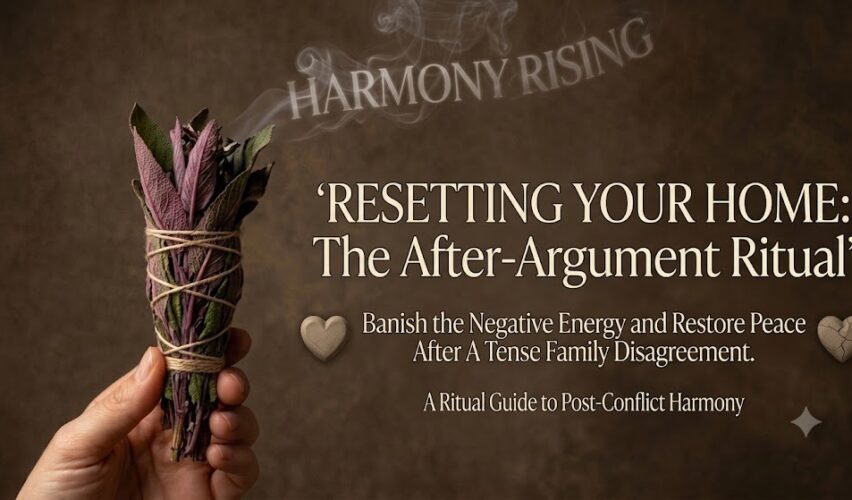
Sage burning after an argument at home means walking a lit, smoldering sage bundle through the rooms where the conflict happened starting at the point of the argument and moving toward an open door or window while setting an intention to release tension, lingering anger, and “stuck” emotional energy from the space. The goal isn’t to erase the disagreement; it’s to keep its emotional residue from soaking into the room, the relationship, and your nervous system.
This guide covers the part almost no other sage article actually covers in depth: what to do specifically after a fight not a generic “smudge your house” tutorial, but a conflict-recovery ritual, including timing, what to say, how to handle a partner who’s still upset, kid-safe versions, and what to do when you can’t legally or safely burn anything at all.
Why This Is Different From a Regular Smudging Routine
Most sage guides treat “after an argument” as a single bullet point buried inside a generic list of reasons to smudge alongside moving house, feeling stuck, or general weekly maintenance. That’s a gap. An argument isn’t a vague “bad vibe.” It has a start point, a flashpoint room, two (or more) emotionally activated people, and often a partner who isn’t on board with rituals at all. A generic smudging walkthrough doesn’t address any of that.
This article focuses entirely on the post-conflict scenario: the specific room sequencing, the language you use while you’re still a little raw, how to do it solo versus with your partner, and how to handle the practical friction of doing a ritual in a home where someone is annoyed, skeptical, or still in the next room cooling off.
Why People Reach for Sage After a Fight
After an argument, most people aren’t looking for spirituality they’re looking for a way to mark the end of the conflict and signal to their own nervous system that it’s safe to come down from high alert. Sage burning after an argument at home works for three overlapping reasons:
- Sensory reset. A strong, unfamiliar smell interrupts the “loop” your brain runs after a fight replaying lines, rehearsing comebacks, staying activated. New smoke smell signals “this moment is over, a new one is starting.”
- Ritual closure. Arguments often end without resolution someone walks away, the topic just dies. A short ritual gives the moment a deliberate ending instead of an abrupt, unresolved one.
- Shared, low-stakes reconciliation gesture. Lighting a bundle together (or even just being in the room while your partner does) is a low-pressure way to physically re-enter shared space without immediately having to talk.
None of this requires belief in “negative energy” literally clinging to your walls. If you want the practical, non-spiritual framing, skip to the Science-Backed View section below.
When Is the Right Time to Smudge After a Fight?
This is the single most-asked question this topic generates, and it’s rarely answered directly anywhere else.
- Wait until the argument has actually stopped not paused. Smudging mid-argument, or right as someone storms off, can come across as dismissive, like you’re trying to “smoke away” their feelings before they’ve been heard.
- The ideal window is 20 minutes to a few hours after, once both people have had a chance to physically and emotionally settle (heart rate down, voice back to normal).
- Don’t smudge as a substitute for the conversation. If the argument needs a follow-up talk, have that first, or do the ritual and agree to revisit the topic later. Smudging clears the air in the room, not the unresolved issue between you.
- Same day is best. Letting tension sit in a room for days tends to mean it shows up again at the next disagreement, in the same room, about something unrelated.
Step-by-Step: How to Smudge After an Argument at Home
Unlike a general home cleanse, post-argument smudging is sequenced around the conflict itself, not the whole house.
- Pause before you light anything. Take 3–5 slow breaths. Lighting sage while you’re still flooded with adrenaline turns the ritual into another way to avoid the moment rather than close it.
- Open a window or door in the room where the argument happened first. This is non-negotiable smoke needs a clear exit path, and symbolically it gives the tension somewhere to go.
- Set a specific intention out loud or silently not a vague “clear bad energy,” but something tied to what actually happened. Example phrasing below.
- Light the sage tip, let it flame for 5–10 seconds, then gently blow it out so it smolders and smokes rather than burns.
- Start exactly where the argument peaked the kitchen, the bedroom, wherever voices were raised not at the front door like a standard whole-home cleanse.
- Move the smoke into corners, behind doors, and any spot where someone was standing when upset. Tension tends to “stick” near where a person was physically planted during the conflict focus there.
- Walk the smoke toward the open window or door last, ending the path by releasing the smoke outward.
- Extinguish safely by pressing the smoldering end into sand, salt, or a fireproof dish never water, which ruins the bundle.
- Reset the room physically, not just energetically: open curtains, turn on a lamp, straighten anything that got knocked or pushed during the argument. This step is consistently skipped in generic guides, but it matters a visibly “reset” room reinforces the emotional reset.
What to Say While Smudging After an Argument (Exact Phrasing)
Most articles tell you to “set an intention” without giving you words. Here are specific, usable phrases for the post-argument context:
- “I release the tension from this room, not the love in it.”
- “What was said here doesn’t have to live here.”
- “I’m clearing the heat of this moment, not the relationship.”
- “This space gets to start fresh, even if we’re still working things out.”
If you’re doing this with your partner, you can each say one line, or simply stand together in silence while one person walks the smoke silence is a valid and often better option than forced words.
Solo Smudging vs. Smudging With Your Partner
This is a distinction almost no other article makes, and it changes the whole approach.
Doing it alone:
- Useful when your partner has left the room, the house, or isn’t ready to participate.
- Treat it as self-regulation first, space-clearing second the goal is calming your own system as much as the room.
- It’s fine to do this without telling your partner, or to mention it afterward rather than making it a big announcement mid-conflict.
Doing it together:
- Best attempted only after both people have cooled down, not as a way to force resolution.
- Works well as a silent, side-by-side activity it doesn’t require talking, which makes it accessible even if you’re not ready to fully debrief the fight yet.
- Avoid using the ritual to “win” the argument symbolically (e.g., pointedly smudging near your partner). That defeats the purpose and can restart the conflict.
If Your Partner Doesn’t Believe In It (Or Thinks It’s Silly)
This is a real, common, and rarely addressed scenario. A few approaches:
- Reframe it as a sensory reset, not a spiritual claim. “I want to change the smell in here and open the window” lands very differently than “I need to clear the negative energy.”
- Do it without ceremony. You don’t need to narrate the ritual. Light it, walk the room, open a window many skeptical partners are fine with the action itself, just not the explanation.
- Offer an alternative if sage genuinely isn’t welcome: a candle, opening every window for ten minutes, or simply vacuuming and tidying the room can serve the same “reset the space” function without the smoke or the spiritual framing.
- Don’t make it a new argument. If your partner asks you to stop, stop. Insisting on a ritual against someone’s wishes recreates the exact dynamic one person’s needs overriding the other’s that likely caused friction in the first place.
Sage Burning After an Argument With Children in the House
Almost no existing guide addresses kids at all. If children were present for or aware of the argument, consider:
- Skip smoke entirely if a child has asthma, allergies, or is very young. Use the non-smoke alternatives below instead.
- If you do smudge, do it after kids are in bed or in another room thick smoke isn’t appropriate around children, and an open flame walking through the house unsupervised near kids is a real safety issue, not just an etiquette one.
- Talk to kids separately about the argument itself. A ritual in another room doesn’t substitute for a child needing reassurance that the adults are okay. If anything, briefly explaining “we’re airing out the house because we had a disagreement, and we’re okay now” is more reassuring to a child than silence.
Which Sage (and Alternatives) Work Best for This Specific Use Case
- White sage is the most commonly used for this scenario because of its strong, fast-clearing scent useful when you want a quick, noticeable shift after a tense moment.
- Blue sage or sage-and-lavender blends are a gentler option if the argument was emotionally intense and you want a calming rather than a “clearing” effect.
- Palo santo is a good middle ground for a partner who finds straight sage smoke too strong or too “witchy” it has a softer, sweeter smell.
- If burning anything is off the table (rentals, smoke alarms, allergies, fire risk, or a partner who’s against it): a sage-scented mist spray, an unlit sage bundle simply set out, or opening windows with a sage essential oil diffuser gives a similar sensory signal without smoke.
The Science-Backed View: Does It Actually Do Anything?
Sage smoke has been studied for its antimicrobial effects on airborne bacteria in enclosed spaces, which is the most defensible scientific claim around smudging generally. There’s no clinical research specifically on “does burning sage repair relationship tension,” because that’s not a measurable biochemical outcome it’s a psychological and behavioral one. What is well-supported, separately, is that:
- Strong, novel scents can interrupt rumination loops (the repetitive replaying of an argument in your head).
- Shared, low-effort rituals after conflict are associated with faster emotional de-escalation in couples research, simply because they create a clear behavioral “end point” to the conflict.
- Opening windows and airing a room measurably improves indoor air quality and is linked to improved mood, independent of any ritual.
In short: the smoke itself isn’t dissolving an argument. The combination of scent, breath, movement, and a defined start-and-end point to the ritual is doing the psychological work and that’s worth saying plainly, because most sage content overstates the energetic claim and understates the part that’s actually well-supported.
Common Mistakes People Make Doing This Specific Ritual
- Smudging immediately, mid-heat, as a way to shut down the conversation. This reads as avoidance, not resolution.
- Skipping the open window. Smoke that has nowhere to go just lingers and can make the room feel heavier, not lighter.
- Treating it as a replacement for an apology or follow-up conversation, rather than a complement to one.
- Doing it pointedly at or near the other person rather than walking it through the space.
- Forgetting to extinguish it fully before leaving the room a real fire-safety risk, especially right after an emotionally distracted moment.
- Using it every single time you disagree about anything, which can start to feel performative or even passive-aggressive to a partner (“here we go with the sage again”).
Frequently Asked Questions
Is it bad to burn sage right after an argument, or should I wait? Wait until voices and breathing have settled generally 20 minutes to a few hours. Smudging during or immediately after a fight can feel like an attempt to shut down the conversation rather than close it.
Can I smudge without my partner knowing or being involved? Yes. Many people do this solo as a way to self-regulate after a disagreement, especially if their partner has stepped outside or isn’t ready to participate. It doesn’t require both people’s involvement to be effective for you personally.
What do I say when smudging after a fight? Keep it short and specific to the moment, such as “I release the tension from this room, not the love in it.” Silence is also acceptable the words are optional, the airing-out and intention are what matter most.
Is sage burning after an argument bad for a relationship if one partner thinks it’s silly? No, but forcing it on a skeptical partner can recreate the same conflict dynamic. Reframe it as opening windows and changing the smell rather than a spiritual claim, or skip the smoke and just air out the room together.
How long should I let the smoke clear before going back to normal activity? Most people air the room for 10–20 minutes with a window or door open, until the smell has noticeably thinned, before resuming normal use of the space.
What if I don’t have sage on hand right after a fight? A scented candle, an open window, or simply tidying the room you argued in can serve the same “reset” function in the moment sage isn’t required for the psychological benefit of a deliberate, physical reset.
Should I smudge every room or just where the argument happened? Focus on the room where the argument occurred and any space either person retreated to afterward (a bedroom, a home office). You don’t need to do the entire home unless you’re also doing a separate, regular cleanse.
Key Takeaways
- Sage burning after an argument at home is most effective as a closing ritual, not a way to avoid the conversation that still needs to happen.
- Timing matters: wait for the emotional heat to drop before lighting anything.
- The room sequence should start at the conflict’s flashpoint and end at an open window or door.
- Specific intention phrasing beats vague “clear the energy” language.
- If a partner or child is uncomfortable with smoke, non-smoke alternatives achieve a similar sensory reset.
- The psychological mechanism scent, breath, ritual closure is well-supported even without buying into the spiritual framing.
Disclaimer: This content is for general informational and ritual-practice purposes only and is not a substitute for couples counseling or professional support if conflict in your home is frequent, escalating, or involves safety concerns.