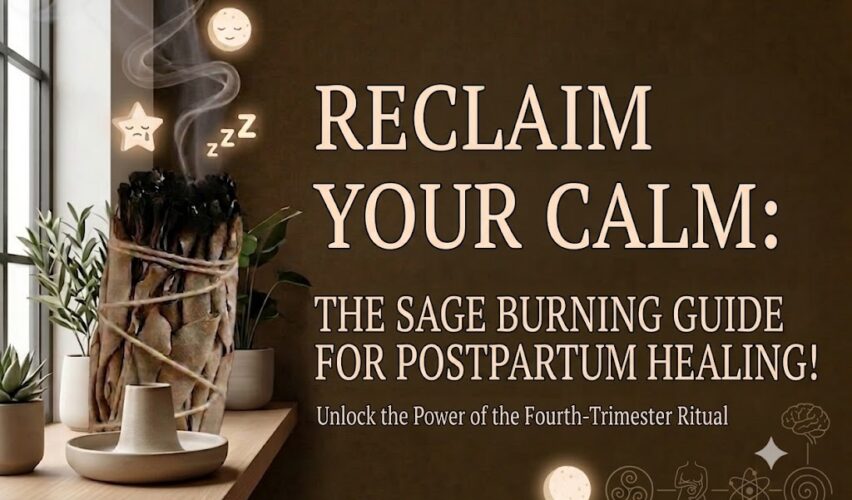
Sage burning for postpartum healing is the practice of burning dried sage usually as a smoke cleanse or “smudge” during the fourth trimester to symbolically clear stagnant energy, mark the transition into motherhood, and support emotional recovery after birth. It is a ritual and emotional wellness practice, not a medical treatment. It carries real safety considerations around newborn lungs, C-section recovery, and postpartum hormones that general sage-burning guides don’t address which is exactly what this article covers.
Introduction: Why Postpartum Sage Burning Deserves Its Own Conversation
Search “sage burning” and you’ll find hundreds of articles on cleansing your home, clearing negative energy, or smudging before a full moon. What you won’t find as easily is guidance built specifically around the body you actually have six days or six weeks after giving birth: a healing perineum or incision, engorged or letting-down breasts, a newborn breathing the same air as you, and a nervous system running on interrupted sleep and shifting hormones.
That gap matters. A postpartum body is not a “normal” body, and a general smudging tutorial that tells you to walk room to room waving a smoking bundle simply wasn’t written with a five-day-old baby’s lungs, a stitched incision, or a mother managing the early signs of postpartum depression in mind. This guide fills that gap directly: the cultural context, the safety science, the newborn-specific precautions, the sustainability and cultural-respect questions no one likes to bring up, and a step-by-step ritual you can actually use during the fourth trimester.
What Is Sage Burning for Postpartum Healing?
Sage burning for postpartum healing refers to burning dried sage leaves typically bundled into a stick or loose in a bowl over charcoal during the weeks or months following childbirth, with the specific intention of:
- Marking the symbolic close of pregnancy and birth
- Clearing the emotional residue of a difficult, traumatic, or simply overwhelming birth
- Creating a sensory “reset” during the disorientation of early motherhood
- Preparing the home and nursery energetically before visitors meet the baby
- Supporting a personal or cultural “closing of the womb” ceremony
It sits at the intersection of two much older traditions: smudging, a specific spiritual practice belonging to certain Indigenous cultures of North America (more on why that distinction matters below), and the near-universal postpartum cleansing ritual found in dozens of cultures worldwide from Latin American limpias to Chinese zuo yuezi purification customs to Ayurvedic postnatal rites in India.
Why New Mothers Are Drawn to This Practice
Most articles stop at “sage clears negative energy.” Postpartum mothers are usually looking for something more specific. Based on how this ritual is actually used during the fourth trimester, the draw tends to fall into four categories:
1. Marking a threshold. Birth is one of the few universally recognized rites of passage left in modern life, yet Western culture offers almost no ceremony around it. Burning sage becomes a self-created ritual to mark “I am not who I was before this.”
2. Processing a hard birth. Mothers recovering from an unplanned C-section, a traumatic delivery, or a birth that didn’t go as planned often describe sage burning as a way to somatically “release” what the body went through, even without formal therapy.
3. Protecting new energy in the home. Many mothers want to cleanse the space before the baby comes home from the hospital, or before the first wave of visitors arrives treating the ritual as a boundary-setting tool as much as a spiritual one.
4. Fighting the isolation of early motherhood. Unlike almost every other culture on earth, mainstream Western postpartum care offers little structured ritual or community support. Sage burning is frequently a mother’s way of building her own ceremony where the culture around her doesn’t provide one.
The Cultural Root System: What Most Blogs Get Wrong
This is the part general sage-burning content almost never covers accurately, and it matters for both respect and SEO/AEO authority.
Smudging is not generic. The word “smudging” as a smoke-cleansing ceremony using white sage (Salvia apiana) belongs specifically to certain Indigenous nations of North America, where it is tied to particular protocols, prayers, and lineage — not a wellness trend. Using the word “smudging” loosely, or burning white sage without any connection to its origin, is a point of real controversy and, for many Indigenous communities, a harmful appropriation of a sacred practice.
Postpartum smoke and herb cleansing, however, is genuinely global — separate from the specific practice of smudging:
| Culture | Practice | Postpartum Purpose |
|---|---|---|
| Latin America | Limpia (spiritual cleansing), often with rosemary, copal, or other local herbs | Ward off negative energy, close the birth cycle during la cuarentena (40-day rest) |
| Traditional Chinese medicine | Herbal steam baths, moxibustion (mugwort smoke near acupuncture points) | Restore “warmth,” rebalance qi during zuo yuezi |
| Thailand | Herbal steam baths, sometimes smoke from medicinal herbs | Dry the perineum, expel “poisonous water” |
| Native American traditions (specific, nation-dependent) | Ceremonial smudging with sacred plants, sweat lodge, ritual bathing | Mark transition into motherhood, purification |
| Middle East / North Africa | Bakhoor and oud incense burning in the home | Welcome the baby, mark the 40-day confinement |
| Various European folk traditions | Juniper or rosemary smoke | Protect mother and infant from illness |
The takeaway for a postpartum blog: if you’re recommending sage burning to a general audience, the responsible and SEO-authoritative move is to (a) distinguish smudging from generic sage burning, (b) note the cultural-appropriation concern honestly, and (c) offer sustainably grown garden sage (Salvia officinalis) or alternative herbs as the accessible, respectful option for people outside those specific lineages. Almost no competing article makes this distinction which is precisely the gap this section closes.
What the Research Actually Says (No Overselling)
Direct and honest, for AEO purposes:
- There is no clinical evidence that burning sage treats postpartum depression, anxiety, or physical healing. No peer-reviewed study has tested sage smoke against postpartum outcomes.
- There is limited, mixed evidence that some compounds in sage smoke (thujone-containing terpenes) have antimicrobial properties in lab settings this has nothing to do with mood or postpartum recovery and should not be used to justify inhalation claims.
- Clary sage essential oil is a different substance entirely and gets conflated with sage burning constantly. Clary sage oil (used diluted, topically, or diffused never burned) has some traditional and limited evidence for labor support and hormone balance, but it is not the same plant part, delivery method, or safety profile as dried sage leaf smoke. If you’ve seen “sage helps postpartum hormones” claims, they are very often talking about the oil, not the smoke and conflating the two is one of the most common inaccuracies across existing content.
- The documented benefit of ritual itself is real, even without smoke. Research on postpartum traditions across 51 studies and 20+ countries found that structured rituals and social support during the postpartum period were associated with lower rates of reported physical symptoms and depression not because of any specific herb, but because of ritual, structure, and care. This reframes sage burning accurately: the healing power is in the ritual and intention, not a pharmacological effect of the smoke.
Safety First: What No General Sage-Burning Guide Tells New Mothers
This is the single biggest content gap in existing articles, and the most important section for a postpartum-specific audience.
For the baby
- Newborn lungs are not developed enough to safely process indoor smoke of any kind, including sage. The American Academy of Pediatrics’ guidance against secondhand smoke exposure applies broadly to particulate smoke inhalation in infant environments, not just tobacco.
- Never burn sage in the same room as the baby, and ventilate thoroughly (open windows, fan, or door) for at least 30–60 minutes before bringing baby back into that space.
- If your baby has any respiratory vulnerability (premature birth, RSV history, reflux with aspiration risk), skip smoke entirely and use one of the smoke-free alternatives below.
For you
- A C-section incision or a healing perineal tear does not interact with smoke directly, but the physical act of walking room to room holding a burning bundle often one-handed while also managing a newborn creates real fall and burn risk during a period when balance, core strength, and reflexes are all compromised. Sit or have a support person carry the bundle instead.
- Postpartum hormonal changes can increase respiratory sensitivity in some women, and smoke of any kind (including sage) can trigger coughing, headaches, or irritation more easily than it did pre-pregnancy.
- If you’re managing postpartum asthma, are recovering from a birth with excessive blood loss, or have any lung condition, skip smoke rituals and use the alternatives section below.
- Never leave burning sage unattended sleep deprivation is one of the leading contributors to postpartum home accidents, including fires.
A necessary note on mental health
If sage burning is something you’re reaching for because you feel persistent sadness, disconnection from your baby, intrusive or frightening thoughts, or an inability to function day to day, please know that a ritual is not a substitute for support. These can be signs of postpartum depression or postpartum anxiety, which are medical conditions that respond well to treatment. Speak with your OB, midwife, or a mental health professional. If you are having thoughts of harming yourself or your baby, contact the 988 Suicide & Crisis Lifeline (call or text 988 in the US) or your local emergency number immediately this is urgent and you deserve real-time support, not just a ritual.
Step-by-Step: A Postpartum-Safe Sage Ritual
If you’ve read the safety section and want to proceed thoughtfully, here is a version built around a healing postpartum body rather than a generic wellness routine.
1. Choose your timing intentionally. Many mothers wait until lochia (postpartum bleeding) has fully stopped and any incision has visibly closed often around the traditional “closing of the fourth trimester” markers (day 40, matching la cuarentena and zuo yuezi traditions), though there’s no fixed rule. Some prefer to do a small ritual the day the baby comes home, and a second one at 40 days to mark full recovery.
2. Do it without the baby in the room. Have a partner, friend, or family member hold the baby in a separate, well-ventilated space, or do the ritual while the baby naps elsewhere in the house with the door closed.
3. Sit down for the physical part. Rather than walking the smoke through every room one-handed, sit in a chair with the bundle in a fireproof dish, or ask a support person to carry it through the space for you.
4. Set one specific intention, out loud or written. Generic “clear negative energy” intentions tend to feel hollow postpartum. Something anchored to your actual experience works better: “I release the fear from my birth. I welcome rest. I forgive my body for what it couldn’t control.”
5. Ventilate before baby returns. Open windows for 30–60 minutes minimum. Sniff-test the room if you can still smell smoke strongly, wait longer.
6. Follow with something restorative, not just symbolic a warm drink, a short rest, skin-to-skin time with the baby once the air has cleared. The research on postpartum ritual benefit points to care and structure, not the smoke itself, so pairing the ritual with actual rest amplifies the part that’s proven to help.
Smoke-Free Alternatives (For Newborns, Nurseries, and Sensitive Recoveries)
Because so many postpartum households genuinely shouldn’t have smoke indoors, here are ritual-equivalent options that preserve the intention without the respiratory risk:
- Sage-infused mist spray dried sage steeped in water (cooled, strained) in a spray bottle, sometimes with a few drops of witch hazel, used to “cleanse” a room by mist instead of smoke
- Sage bundle without lighting simply placing a tied, unlit sage bundle in the nursery or under the crib as a symbolic object
- Herbal simmer pot dried sage, rosemary, and citrus peel simmered on the stove (in a well-ventilated kitchen, away from baby) for ambient scent without direct smoke exposure in living spaces
- Sound cleansing a bell, chime, or singing bowl used room to room as an energetic-clearing substitute with zero air-quality impact
- Salt water ritual a small bowl of salt water placed at the doorway, common in several folk traditions, as a non-smoke “protective threshold” ritual
Sage Burning vs. Other Postpartum Cleansing Rituals
| Ritual | Method | Newborn-Safe? | Best For |
|---|---|---|---|
| Sage burning (smoke) | Burning dried leaf bundle | No requires baby out of room | Symbolic release, marking transition |
| Sage mist spray | Water infusion, sprayed | Yes | Nurseries, sensitive lungs |
| Herbal sitz bath | Warm water soak with herbs | N/A (mother only) | Physical perineal healing |
| Simmer pot | Stovetop herbs in water | Yes, if kitchen ventilated | Ambient home scent |
| Salt water threshold | Bowl of salted water at door | Yes | Protective/boundary ritual |
| Sound cleansing | Bell, chime, singing bowl | Yes | Energetic reset with zero air impact |
Sustainability and Sourcing: A Question Almost No One Asks
White sage (Salvia apiana) has been so heavily over-harvested from wild landscapes in California and the American Southwest to meet wellness-industry demand that some Indigenous communities and conservationists have specifically asked non-Native consumers to stop buying wild-harvested white sage bundles. If you want to incorporate sage into a postpartum ritual respectfully and sustainably:
- Choose garden sage (Salvia officinalis) the common culinary sage which is easy to grow, not endangered, and not tied to a specific sacred lineage
- Buy from small farms that cultivate sage specifically for sale, rather than wild-harvested white sage bundles
- Consider rosemary, cedar, mugwort, or lavender as historically and ecologically appropriate alternatives with their own postpartum-relevant traditions (rosemary for clarity and memory, lavender for calm, mugwort for traditional moxibustion-style warmth in TCM-adjacent practice)
- If a practice specifically calls itself “smudging,” consider learning about and supporting Indigenous-led organizations rather than commercial white sage products
This section alone differentiates postpartum-specific sage content from the dozens of generic “how to smudge your home” posts that never touch sourcing ethics.
Frequently Asked Questions
Is it safe to burn sage after giving birth? It can be done safely for the mother in most low-risk recoveries if the baby is not in the room, the space is well-ventilated, and the mother has no respiratory complications. It should be avoided entirely around newborns due to lung immaturity, and skipped altogether by anyone with postpartum asthma, excessive blood loss, or a C-section recovery that limits safe movement.
Can sage burning help with postpartum depression? No clinical evidence supports sage smoke as a treatment for postpartum depression. The ritual and sense of structure some mothers experience may offer emotional comfort, but postpartum depression is a medical condition that needs evaluation and treatment from a healthcare provider not a substitute ritual.
What’s the difference between sage burning and smudging? Smudging is a specific ceremonial practice belonging to certain Indigenous nations of North America, tied to particular protocols and spiritual lineage. “Sage burning” as a general wellness practice using garden sage or store-bought white sage bundles is a separate, more generic activity, and using the word “smudging” for it is considered disrespectful by many Indigenous communities.
When after birth should I burn sage? There’s no medical requirement, but many mothers wait until bleeding (lochia) has stopped and any incision has healed, often aligning with traditional closing points like day 40 (matching global 40-day postpartum confinement traditions) or the day baby first comes home.
Is sage burning safe around a newborn? No. Newborn lungs cannot safely process indoor smoke particulates. Do the ritual in a separate, well-ventilated room while someone else holds the baby, and ventilate for 30–60 minutes before bringing the baby back in.
What can I use instead of burning sage if I have a newborn at home? Sage-infused mist spray, an unlit sage bundle placed symbolically, a stovetop herbal simmer pot, sound cleansing with a bell or singing bowl, or a salt water threshold ritual all offer a similar symbolic effect without smoke exposure.
Does clary sage oil work the same way as burning sage? No. Clary sage essential oil is a completely different product with different (and separately debated) traditional uses around hormone balance and labor support. It should never be burned, and burning dried sage leaves has no relationship to the effects attributed to the essential oil.
Final Thoughts
Sage burning for postpartum healing sits in genuinely useful territory: a low-cost, low-effort ritual that can mark a real transition during a period Western culture rarely honors with ceremony. But it deserves to be practiced with the same care postpartum bodies need in every other area away from newborn lungs, seated rather than walked, sourced sustainably and respectfully, and never mistaken for a treatment for postpartum depression when real support is needed. Used with that awareness, it becomes what it was always meant to be: a small, intentional act of closing one chapter and opening another.
This article is for general informational purposes and reflects cultural and wellness practices, not medical advice. Always consult your OB-GYN, midwife, or a licensed mental health professional for any physical or emotional postpartum concerns.