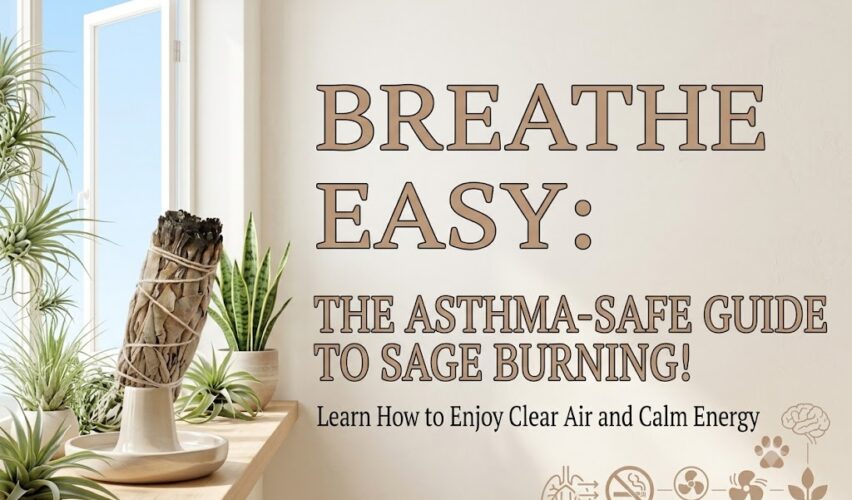
Can people with asthma burn sage safely? People with asthma can smudge with caution, but sage smoke is not asthma-safe by default. Sage smoke contains fine particulate matter (PM2.5) that can irritate the airways and trigger bronchospasm regardless of asthma severity. Mild, well-controlled asthma may tolerate brief, well-ventilated smudging from a distance of 6+ feet, while moderate-to-severe or poorly controlled asthma should avoid inhaling any smoke and use smoke-free alternatives instead. Always keep a rescue inhaler within reach and stop immediately at the first sign of coughing, tightness, or wheezing.
Why Most Sage-Burning Articles Get This Wrong
Search “sage burning and asthma” and you’ll find the same recycled line in almost every article: “Those with asthma should avoid burning sage.” That’s it. One sentence, buried in a benefits list, with no real guidance for the millions of people who have asthma but still want to smudge for cultural, spiritual, or wellness reasons.
Nobody is answering the actual questions people have:
- How much smoke exposure is actually risky for an asthmatic?
- Is there a “safe” way to smudge with asthma, or is it an all-or-nothing decision?
- What do I do if my asthma reacts mid-ceremony?
- Are there smoke-free ways to get the ritual benefit without the respiratory risk?
This guide fills that gap. It’s written as a precaution-and-protocol resource, not a general “benefits of sage” post because you don’t need another article telling you sage smells nice. You need a plan.
How Sage Smoke Actually Affects the Lungs
To take the right precautions, it helps to understand why sage smoke bothers asthmatic airways in the first place. It isn’t superstition it’s basic combustion chemistry.
1. Fine Particulate Matter (PM2.5)
When dried sage burns, it releases particles smaller than 2.5 micrometers small enough to bypass your nose and throat’s natural filters and settle deep into the alveoli (the tiny air sacs where oxygen exchange happens). Independent air-quality sampling on smudging sessions has repeatedly found particulate levels well above standard indoor air quality thresholds, even during a single, short session in an average-sized room.
2. Airway Inflammation
Asthmatic airways are chronically hyperresponsive, meaning they overreact to irritants that wouldn’t bother a healthy respiratory system. PM2.5 and combustion byproducts trigger the same inflammatory cascade as smoke from a candle, fireplace, or incense swelling of the bronchial lining, increased mucus production, and airway narrowing.
3. Thujone Exposure
Common sage (Salvia officinalis) contains thujone, a compound that in high concentrations affects the nervous system. The amount released during typical smudging is small, but combined with combustion irritants, it adds another variable that sensitive respiratory systems don’t need.
4. It’s Not About “Bad” Smoke vs. “Good” Smoke
A common myth is that sage smoke is somehow gentler than other smoke because it’s “natural” or “cleansing.” Physiologically, your lungs don’t differentiate. Combustion particles from sage, palo santo, incense, or wood all carry the same category of respiratory risk.
The 11 Precautions to Take Before, During, and After Smudging
Before You Light the Bundle
1. Check your asthma control level first. If you’ve needed your rescue inhaler more than twice in the past week, or your peak flow readings are below your personal best, this is not the week to smudge. Wait until your asthma is well-controlled.
2. Ventilate the space at least 15 minutes in advance. Open a window and, ideally, a door on the opposite side of the room to create cross-ventilation before you even strike the match.
3. Position yourself near an exit, not in a corner. Choose a spot where you can step outside quickly if needed, rather than the center of an enclosed room.
4. Keep your rescue inhaler within arm’s reach. Not in another room. Not in a bag. On the table next to you.
5. Run a HEPA air purifier during the session. A HEPA-rated purifier actively pulls PM2.5 particles out of the air rather than just diluting them, which matters more for asthma than open windows alone.
During the Smudging Session
6. Stay at least 6 feet from the smoke source. Distance dramatically reduces the concentration of particulates you inhale. Waving smoke around a space is different from standing directly over it.
7. Keep the session under 3–5 minutes. Shorter exposure time directly reduces cumulative particulate inhalation. Long, drawn-out smudging rituals increase risk with every additional minute.
8. Avoid closed, low-ceiling rooms entirely. Bathrooms, closets, and small bedrooms trap smoke concentration far above what open-plan spaces do.
9. Extinguish immediately at the first symptom. Coughing, throat tightness, chest tightness, or a change in your breathing pattern is your signal to stub out the bundle in a fireproof dish right away don’t try to “push through” the ritual.
After Smudging
10. Leave the room until the smoke fully clears. Re-entering too soon exposes you to lingering particulate matter that hasn’t yet dissipated, even after the visible smoke is gone.
11. Monitor for delayed symptoms for 2–4 hours. Some asthmatic reactions to smoke exposure are delayed rather than immediate. Keep your inhaler accessible and don’t schedule strenuous activity right after a session.
Who Should Avoid Burning Sage Completely
Precautions reduce risk they don’t eliminate it. For some groups, the safer, medically sound choice is to skip burning altogether:
- Moderate-to-severe or poorly controlled asthma even brief, distant smoke exposure can trigger bronchospasm.
- Children with asthma developing lungs are more reactive to particulate matter, and kids often can’t self-report early symptoms.
- Anyone with a recent asthma flare-up, hospitalization, or respiratory infection the airways are already inflamed and hypersensitive.
- People with co-occurring COPD, bronchitis, or chronic lung conditions the combined irritant load is higher risk than asthma alone.
- Pregnant individuals with asthma reduced lung capacity and shared blood oxygen with the fetus make smoke exposure a bigger concern.
- Households with birds this doesn’t apply to human asthma, but birds’ respiratory systems are extremely smoke-sensitive, so a household member’s pet shouldn’t be in or near the space either way.
If you fall into any of these categories, the alternatives below give you the ritual without the respiratory gamble.
Smoke-Free Alternatives That Still Deliver the Ritual
You don’t have to choose between honoring the practice and protecting your lungs. These alternatives are increasingly used by people with asthma who still want a cleansing or grounding ritual:
- Sage-infused sprays or mists the scent and intention without any combustion.
- Battery-powered smudge simulators (LED “smoke” bundles) visual ritual cue, zero particulate output.
- Essential oil diffusers with sage or white sage oil dispersed scent without smoke chemistry.
- Dried sage displayed unburned some traditions use the herb’s presence and scent alone as a purifying symbol.
- Sound cleansing (bells, singing bowls) paired with intention-setting a smoke-free companion or full substitute for the ritual moment.
These options aren’t a lesser version of the practice they’re a modification that keeps the intention intact while removing the one variable (combustion smoke) that’s medically incompatible with asthma.
What To Do If Sage Smoke Triggers an Asthma Attack
- Stop the exposure immediately extinguish the sage and leave the room or open all windows and doors.
- Use your rescue inhaler (typically albuterol) as prescribed usually 2 puffs, waiting per your action plan.
- Sit upright, not lying down this makes breathing easier and reduces panic-driven shallow breathing.
- Follow your personal Asthma Action Plan if you have one from your doctor.
- Call emergency services if symptoms don’t improve within a few minutes of inhaler use, if lips or fingertips turn bluish, or if you can’t speak in full sentences.
If you don’t currently have a written Asthma Action Plan, this is a good reason to request one at your next doctor’s visit especially if smudging is part of your regular routine.
Talking to Your Doctor Before You Smudge
Because asthma severity varies so widely person to person, a quick conversation with your doctor or allergist is worth having before deciding how (or whether) to proceed. Useful questions to ask:
- “Is my current asthma control stable enough to tolerate brief smoke exposure?”
- “Should I pre-treat with my inhaler before a planned smudging session?”
- “What symptoms would mean I should stop permanently, not just for one session?”
This is especially relevant if you’re smudging for cultural or religious reasons and want a doctor-informed way to continue safely, rather than being told to avoid it altogether.
Frequently Asked Questions
Is sage smoke worse for asthma than incense or candle smoke? Not inherently. All combustion smoke sage, incense, candles, palo santo releases fine particulate matter that can irritate asthmatic airways. Sage isn’t uniquely dangerous, but it’s not uniquely safe either.
Can I smudge if my asthma is mild and well-controlled? Possibly, with precautions: good ventilation, distance from the smoke, a short session, and your inhaler nearby. “Mild and well-controlled” is not the same as “no risk,” so monitor yourself closely the first time.
How long should I wait after smudging before it’s safe to enter the room? Wait until the smoke has visibly cleared and continue ventilating for at least 20–30 minutes afterward, since fine particulates can linger in the air longer than visible smoke.
Does opening a window make sage smoke fully safe for asthma? Ventilation reduces concentration but doesn’t eliminate risk. A HEPA air purifier combined with ventilation is more effective than an open window alone.
Can children with asthma be in the house while sage is burned in another room? It’s safer to keep children with asthma out of the home entirely during smudging, or at minimum in a separate, well-sealed room with the door closed and away from any shared ventilation.
Are sage sprays a real substitute for burning sage? For the sensory and ritual experience, yes they deliver scent and intention-setting without any combustion byproducts, making them a genuinely asthma-safe alternative rather than a compromise.
Key Takeaways
- Sage smoke carries the same category of respiratory risk as any other combustion smoke, regardless of its cultural or spiritual reputation.
- Asthma severity determines your risk level mild and well-controlled asthma has more room for caution-based smudging than moderate-to-severe asthma.
- Ventilation, distance, short sessions, and an accessible rescue inhaler are the four pillars of safer smudging with asthma.
- Smoke-free alternatives exist that preserve the ritual without the respiratory trade-off.
- When in doubt, a quick conversation with your doctor turns guesswork into a personalized, medically informed decision.