
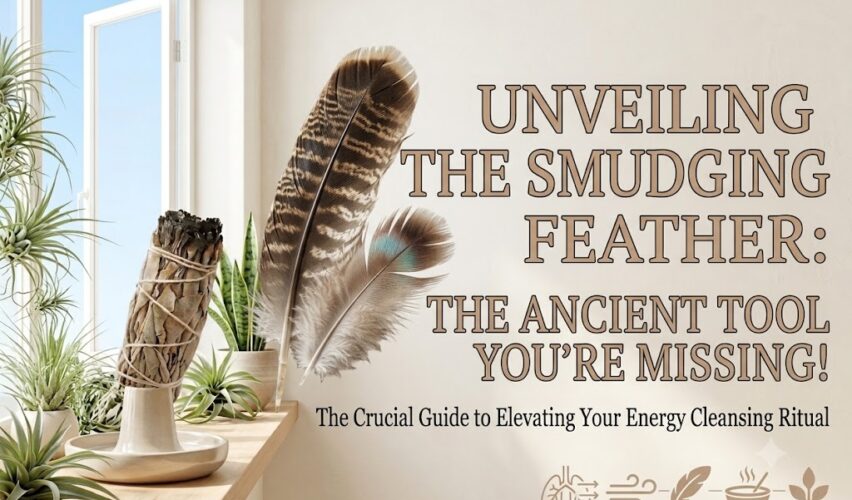
A smudging feather is a tool used to direct and fan the smoke produced when burning sacred herbs like sage, cedar, or sweetgrass during a smudging ceremony. Rather than letting smoke drift on its own, the feather lets you guide it deliberately over a person’s body, into the corners of a room, or across an object you want to cleanse. In Indigenous traditions, the feather represents the element of Air and is considered a bridge between the physical and spiritual world, not just a fanning tool.
This guide covers what most articles skip: which feathers are legal to own, how to choose and care for one, the exact technique for using it, and what to do if a feather isn’t an option for you.
What Does a Smudging Feather Actually Do?
A smudging feather has three practical jobs:
- Directs smoke to specific areas your body, a doorway, a corner of a room, an object
- Keeps the herb bundle smoldering by fanning gentle air across the embers
- Carries symbolic weight as the element of Air, completing the four-element balance (earth, fire, water, air) present in many Indigenous smudging traditions
It is not required for smudging to “work” many people smudge with their hand alone but it adds precision and ceremonial intention to the practice.
Where the Feather Fits in Smudging Symbolism
In North American Indigenous traditions, birds are seen as messengers between humans and the Creator. Because they fly closest to the sky, feathers are believed to carry prayers upward as the smoke rises. This is why the feather isn’t treated as a household object it’s handled with the same respect given to the herb bundle itself.
Different feathers carry different meanings depending on the bird and tradition:
| Feather Type | Common Symbolism | Legal Status in the US |
|---|---|---|
| Turkey | Abundance, gratitude, blessing | Legal to own and buy |
| Hawk | Vision, focus, messages from the Creator | Regulated — protected under federal law |
| Eagle | Highest honor, direct connection to the Creator | Restricted to enrolled members of federally recognized tribes with a permit |
| Goose/Duck | Everyday cleansing, accessible substitute | Legal, commonly farmed |
| Peacock | Renewal, beauty (used more in New Age practice than Indigenous tradition) | Legal to own |
The Part Almost No One Tells You: Is It Legal to Own a Smudging Feather?
This is the single biggest gap in most smudging content and it matters before you buy or pick one up.
In the United States, wild bird feathers are protected under the Migratory Bird Treaty Act (1918), which makes it illegal to possess, sell, or transport feathers or any part of almost any native wild bird, including hawks, owls, and songbirds, even if you find a feather on the ground. There’s no exception for “I found it, I didn’t kill anything.”
Eagle feathers carry even stricter protection under the Bald and Golden Eagle Protection Act. Only enrolled members of federally recognized tribes, holding a valid permit, may legally possess eagle feathers, which must come through the National Eagle Repository. Non-Native possession of an eagle feather even one inherited or gifted can result in fines up to $100,000 and up to a year in prison for a first offense.
What this means practically:
- Feathers labeled “turkey,” “goose,” or “farmed pheasant” are the only wild-type feathers legally sold and owned freely because these species are farmed, not wild-caught
- If you’re not an enrolled tribal member, avoid any feather marketed as “eagle” or “hawk” unless it’s clearly a dyed/replica feather (many sellers dye turkey feathers to resemble eagle feathers, which is legal and common)
- If you’re Native American, the eagle feather permitting process runs through the U.S. Fish and Wildlife Service this is worth knowing before assuming a feather passed down in your family is automatically compliant
This isn’t a technicality to skip. It’s the difference between a peaceful ritual and a federal violation.
Is Using a Feather Cultural Appropriation?
This depends on intention and sourcing, and reasonable people land in different places on it. A few grounded guidelines that Indigenous educators commonly point to:
- Buy from Indigenous-owned sellers when possible, rather than mass-market “boho” retailers that strip the practice of its origin and context
- Use the feather with a sense of purpose, not as home décor or an aesthetic prop
- Avoid eagle feathers entirely unless you have a legitimate cultural or legal claim to them this respects both the law and the tradition
- If in doubt, use a non-feather alternative (covered below) it doesn’t diminish the ritual
How to Use a Smudging Feather: Step-by-Step
What You’ll Need
- A dried herb bundle (sage, cedar, sweetgrass, or palo santo) or loose herbs
- A heatproof, fireproof bowl or abalone shell to catch ash
- A lighter or match
- Your feather
Step 1: Set Your Intention
Before lighting anything, pause and name what you want to release or invite. This step is often skipped, but it’s what separates smudging from simply airing out a room.
Step 2: Light the Herb, Then Let It Smolder
Light the tip of the bundle and let it burn for about 20–30 seconds, then gently blow out the flame so it produces smoke rather than fire. You want smoke, not embers licking upward.
Step 3: Hold the Feather Correctly
Grip the feather by its quill (the hard base), not the soft plume. Hold your bowl or shell in your other hand, positioned beneath the smoldering herb to catch falling ash.
Step 4: Fan Don’t Blow
Use gentle wrist flicks to waft the smoke, rather than blowing air from your mouth (blowing is generally considered disrespectful in traditional practice, since breath carries its own meaning). A slow, deliberate fanning motion works best.
Step 5: Direct the Smoke With Purpose
For a person’s body: Starting at the head, sweep the feather downward past the front and back of the body, then the arms and legs, ending at the feet. Some traditions move counterclockwise to release, others clockwise to invite follow whichever tradition you’re drawing from, or move in the direction that feels intentional to you.
For a room: Walk the perimeter, fanning smoke toward corners, closets, and behind doors these are considered places where stagnant energy collects. Move toward an open window or door at the end so smoke (and whatever it’s carrying) has somewhere to exit.
For an object: Hold the item just above the smoke and fan it across all sides, including the underside.
Step 6: Extinguish Safely
Press the smoldering end into sand, dirt, or your ash bowl until it’s fully out. Never run it under water this damages the herb bundle for reuse and can crack a shell dish from thermal shock.
How to Choose the Right Smudging Feather
- For beginners: a turkey feather is affordable, ethically uncomplicated, and large enough to move smoke effectively
- For daily/personal use: a smaller goose or duck feather is easier to store and travel with
- For gifting: a feather with a beaded quill wrap is a traditional way to formalize a smudging set as a gift
- Found feathers: even if legal for the species, only use feathers from farmed or domestic birds (chicken, turkey, goose) that you can verify the source of wild-found feathers of protected species carry legal risk regardless of intent
How to Cleanse, Charge, and Store a Smudging Feather
A feather absorbs smoke and, in many traditions, is believed to hold onto the energy it moves so it needs its own care routine, separate from the herb bundle:
- Cleanse it periodically by passing it briefly through sage or cedar smoke itself (yes, a feather can be smudged)
- Charge it by leaving it in moonlight overnight, especially during a full moon, or resting it near a crystal like clear quartz or selenite
- Store it wrapped in a natural-fiber cloth (cotton or silk), away from direct sunlight, which can dry out and split the vane over time
- Don’t store it loose in a junk drawer with unrelated items most practitioners treat this as disrespectful to its ceremonial role
What If You Can’t or Don’t Want to Use a Feather?
This is worth addressing directly, since almost no other article does. Good reasons to skip the feather entirely include respecting cultural boundaries, legal restrictions, or simply not having one on hand. None of these should stop you from smudging:
- Your hand the most universally accepted substitute; simply fan the smoke with an open palm
- A dried plant stem (like a bundle of lavender or rosemary sprigs) used in several folk traditions as an air-element substitute
- A folded paper or cloth fan practical, especially for people with feather allergies
- A small handheld fan modern and equally effective for directing smoke in a room
None of these are lesser methods. The intention behind the ritual carries more weight than the tool used to perform it.
Frequently Asked Questions
What is a smudging feather used for? It’s used to fan and direct smoke from burning sacred herbs during a cleansing ritual, guiding it over a person, room, or object while symbolically representing the element of Air.
Can anyone own an eagle feather for smudging? No. In the United States, only enrolled members of federally recognized Native American tribes, with a permit through the U.S. Fish and Wildlife Service, may legally possess eagle feathers.
What feather is best for smudging if you’re not Native American? A turkey, goose, or duck feather from a farmed bird is the safest and most widely accepted legal option.
Do you have to use a feather to smudge? No. A hand, small fan, or dried plant stem works just as well to direct smoke. The feather adds symbolism and tradition but isn’t mechanically required.
Is it disrespectful to buy a smudging feather online? It depends on the seller. Buying from Indigenous-owned businesses, or from sellers using ethically farmed feathers (not wild-caught protected species), is generally considered respectful. Mass-produced “boho decor” versions stripped of context draw more criticism.
How do you clean a smudging feather? Pass it briefly through sage or cedar smoke to cleanse it energetically, and wipe the quill with a dry cloth if it collects ash residue. Avoid water, which can damage the vane.
Can you use a dyed feather instead of a real eagle feather? Yes many sellers dye turkey feathers to resemble eagle feathers for visual purposes. This is legal and a common, respectful alternative for people who want the aesthetic without violating federal protections.
Final Thought
A smudging feather is a small object carrying a lot of meaning spiritual, cultural, and legal. Used with the right knowledge, it turns a simple act of burning herbs into a deliberate, respectful ritual. Whether you use an eagle feather passed down through generations, a turkey feather from a local shop, or your own open hand, what matters most is the intention you bring to the smoke.