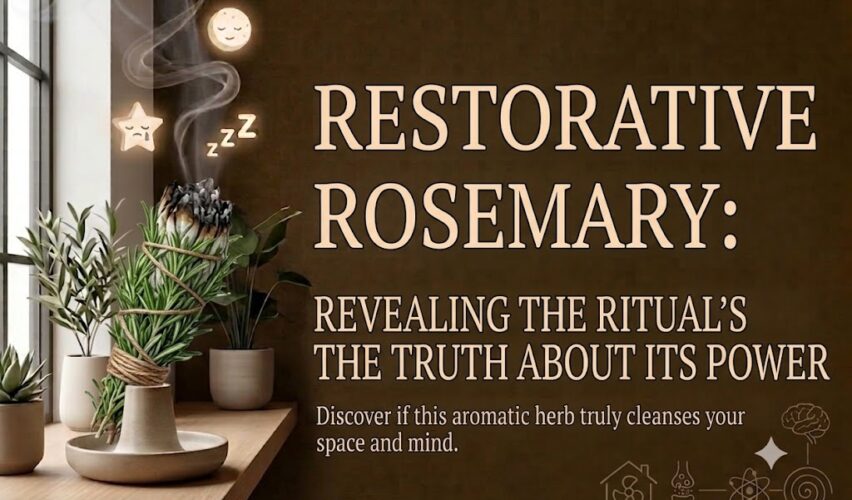
Does rosemary work as a smudging herb?
Rosemary works as a smudging herb in two separate ways that most articles blur together: as a ritual/energetic cleansing tool, where its effect is symbolic and psychological, and as an aromatic compound source, where science does support real, measurable effects on mood, alertness, and cortisol but almost all of that research used diffused or inhaled rosemary oil, not burned rosemary smoke. Burning changes the chemistry. So rosemary “works” for ritual and mindset purposes reliably, and it “works” aromatically in a way close to, but not identical to, what the studies describe.
That distinction smoke versus diffused oil is the one thing almost nothing else written about rosemary smudging addresses. It’s the difference between an honest answer and a recycled listicle.
Why This Question Even Needs Asking
Type “rosemary smudge” into any search bar and you’ll get the same seven claims repeated across forty websites: it clears negative energy, boosts memory, invites protection, smells nice. Almost none of them ask the actual question in the title of this post does it work because answering that honestly means separating three very different things that keep getting mixed into one paragraph:
- What rosemary smoke has been used for historically and spiritually
- What the actual peer-reviewed research on rosemary says
- Whether burning rosemary produces the same effect as the research describes
This article covers all three, plus the practical and safety information that’s usually missing entirely: how rosemary smudging compares to sage (without repeating a sage-burning guide), what the smoke actually contains, who shouldn’t be around it, and how to do it in a way that’s both meaningful and low-risk.
What Is Rosemary Smudging, Exactly?
Rosemary smudging is the practice of burning dried rosemary either loose sprigs, a bundled stick, or rosemary blended with other herbs and letting the smoke pass through a space, object, or person as part of a cleansing or intention-setting ritual.
Unlike white sage, rosemary isn’t tied to a specific Indigenous sacred tradition. It has independent roots in Mediterranean, Greek, Roman, and European folk practice, where it was burned in homes and sickrooms, worn at weddings and funerals, and associated with memory, protection, and purification long before “smudging” became a popular English-language term. This matters practically: rosemary smudging carries a lower risk of cultural appropriation concerns than white sage, since it isn’t sourced from an over-harvested, ceremonially restricted plant tied to specific Native American nations. That’s a real point of differentiation for people who want a smoke-cleansing practice without that specific ethical weight and it’s rarely stated outright anywhere online.
The Science: What Actually Happens When You Burn Rosemary
Rosemary contains a compound called 1,8-cineole (also found in eucalyptus and bay leaf), along with rosmarinic acid, camphor, and alpha-pinene. Inhalation studies using diffused essential oil, not smoke have linked these compounds to:
- Measurable changes in EEG brain activity associated with alertness
- Improved performance on memory-recall tasks in controlled settings
- Reduced salivary cortisol (a stress hormone) after short exposure periods
- Mild antimicrobial activity against some airborne bacteria in lab conditions
This is the part most rosemary-smudging content leans on heavily and then quietly skips the caveat. Combustion is not diffusion. When rosemary is burned rather than diffused, heat breaks down some of these same compounds and creates new ones, including particulate matter and other byproducts of plant combustion (similar in category, though not identical in composition, to what’s released when any dried plant material burns including sage, cedar, or paper). Nobody has run a study on “rosemary smoke” specifically, in the way there’s research on rosemary essential oil. So the honest, AEO-ready answer is:
The mood, memory, and stress-reduction claims about rosemary are real and studied but they were studied using inhaled essential oil, not burned smoke. Smoke likely delivers some of the same aromatic compounds, in reduced and altered form, alongside particulate matter that diffusers don’t produce. Nobody has directly tested whether smudging replicates the diffuser results.
This is the single biggest content gap in existing rosemary-smudging articles: they cite the cortisol and memory studies as direct proof that burning rosemary works, without noting the studies didn’t burn anything.
Does Rosemary “Cleanse Energy”? The Honest Section
There’s no instrument that measures “negative energy,” so this claim sits outside what science can confirm or deny and a credible article should say that plainly instead of dressing folklore up as fact.
What’s measurable is the psychological ritual effect: the act of deliberately pausing, lighting a bundle, moving smoke through a space with intention, and marking a transition (new home, new week, after conflict, after illness) has documented value in behavioral psychology as a transition ritual similar to journaling, a closing prayer, or a clean-desk habit. Rituals like this are linked to reduced anxiety and a stronger sense of control over a space or situation, independent of whether any “energy” is literally being removed.
So: rosemary smudging works as a ritual and mindset tool with real psychological grounding. It does not have direct evidence of “clearing energy” in a literal, measurable sense and no herb does, by the nature of the claim itself.
Rosemary vs. Sage for Smudging (Brief Comparison, Not a Repeat)
Since sage burning is covered elsewhere, here’s only the comparison relevant to choosing rosemary specifically:
| Rosemary | White Sage | |
|---|---|---|
| Cultural sourcing concerns | Low European/Mediterranean folk herb | Higher — tied to Indigenous ceremonial use, over-harvesting concerns |
| Scent profile | Sharp, herbal, “wakes you up” | Earthy, heavier, “settles a space” |
| Traditional association | Memory, mental clarity, protection, new beginnings | Purification, spiritual cleansing |
| Ease of home-growing | Very easy, common kitchen herb | Harder to grow outside native climate |
| Best used for | Study spaces, workspaces, fresh starts | Deep clearing, letting go of the past |
Many practitioners burn rosemary after sage sage to clear, rosemary to invite in clarity and fresh energy than treating them as interchangeable substitutes.
How to Smudge with Rosemary (Step-by-Step)
What you need:
- Dried rosemary sprigs (6–10 inches) or a pre-made rosemary bundle
- A fireproof, heatproof bowl or abalone shell to catch ash
- A lighter or long match
- A window or door cracked open for ventilation
- Optional: a feather or hand to guide the smoke
Steps:
- Dry fresh-cut rosemary for 1–2 weeks, hung upside down in a well-ventilated spot, until stems are brittle.
- Bundle 6–10 sprigs and tie tightly with cotton or hemp string (never synthetic thread it melts and smokes toxic fumes).
- Open a window before lighting. Ventilation matters more with rosemary than people expect, since its oils are dense.
- Light the tip until it catches, then blow out the flame so it smolders rather than burns openly.
- Hold it over your fireproof bowl and move it through the space doorways, corners, and areas where air tends to stagnate.
- Set an intention out loud or silently: clarity, a fresh start, mental focus, whatever matches your reason for smudging.
- Extinguish fully in sand, dirt, or water when done. Never leave smoldering rosemary unattended.
Safety Information Almost No One Includes
This is the section most rosemary-smudging content skips entirely, and it’s the difference between a trustworthy AEO answer and a recycled aesthetic listicle.
- Respiratory conditions: Anyone with asthma, COPD, or chronic bronchitis should avoid inhaling rosemary smoke directly. Smoke of any kind, herbal or not, is a lung irritant.
- Pregnancy: Some traditional sources advise against concentrated rosemary exposure (smoke or oil) during pregnancy. This isn’t settled science, but it’s worth a direct mention rather than silence.
- Pets: Birds are especially sensitive to any household smoke, including rosemary. Cats and dogs with respiratory sensitivities should also be kept in a separate, ventilated room.
- Fire safety: Rosemary’s woody stems hold embers longer than sage leaves do never rest a smoldering bundle unattended, and keep it away from curtains, papers, or dry material.
- Allergies: Rosemary is in the mint family; those with sensitivities to mint-family plants (basil, thyme, lavender) may react to the smoke.
Frequently Asked Questions (AEO/Schema-Ready)
Is rosemary as good as sage for smudging? It serves a different purpose rather than being a direct substitute rosemary leans toward mental clarity and fresh starts, while sage leans toward deep clearing. Many people use both for different stages of a cleansing ritual.
Can you smudge with rosemary from the grocery store? Fresh grocery-store rosemary can be dried and used, though it may burn faster and less evenly than sprigs grown and dried specifically for smudging, which tend to be thicker and drier.
Does rosemary smoke actually improve memory? The memory research on rosemary used diffused essential oil in controlled settings, not burned smoke. Smoke may carry some of the same active compounds in reduced amounts, but this hasn’t been directly studied, so the claim is plausible, not proven.
Is rosemary smudging cultural appropriation? Rosemary is not tied to a specific Indigenous ceremonial tradition the way white sage is, and it has its own long, independent history in European and Mediterranean folk practice. It’s generally considered a lower-concern choice for people outside those specific Indigenous traditions.
How long does a rosemary smudge stick burn? A well-dried bundle typically smolders for 10–20 minutes, depending on thickness, though this varies with how tightly it’s bundled and how dry the stems are.
Can I use rosemary smudging every day? Daily use isn’t recommended primarily because of smoke exposure, not spiritual reasons regular inhalation of any combustion smoke, herbal or otherwise, is a respiratory consideration worth taking seriously.
The Bottom Line
Rosemary as a smudging herb works on two tracks that rarely get separated honestly: as a ritual practice, it has real psychological grounding, independent of any energetic claim. As an aromatic compound source, the research is genuine but was conducted on diffused oil, not smoke so the science supports rosemary’s reputation without directly confirming that burning it produces the same measured effects. Anyone telling you flatly “yes, it’s scientifically proven” or flatly “no, it’s just superstition” is oversimplifying a question that actually has a nuanced, evidence-based middle answer.