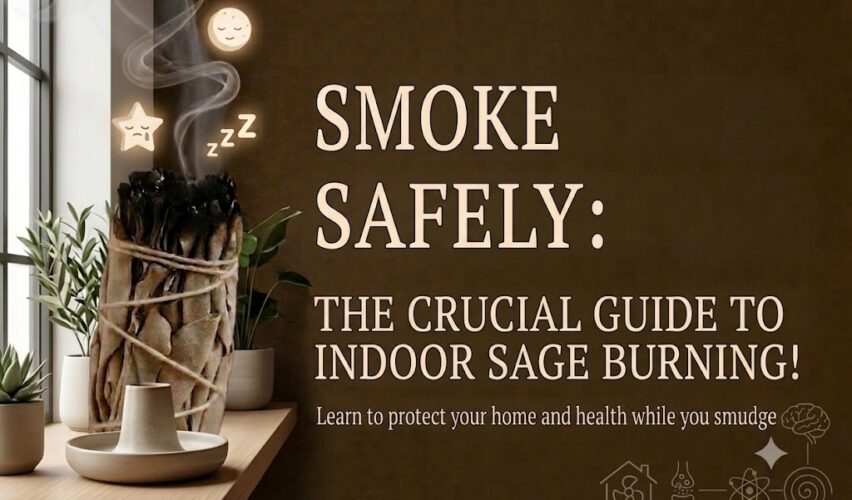
Burning sage indoors is generally safe for short, occasional sessions in a well-ventilated room, away from smoke detectors, pets, and anyone with respiratory or cardiac conditions. It is not safe as a daily habit, in a closed room, in a rental without checking your lease, or around infants, pregnant occupants, birds, or people with asthma/COPD. The risk isn’t the sage itself — it’s indoor smoke, which always contains fine particulate matter (PM2.5) regardless of what’s burning.
That one paragraph answers the search intent. Everything below answers the follow-up questions people actually have once they’ve decided to try it the fire risk, the legal risk, the pet risk, and the “how long is too long” questions that most sage-burning guides skip entirely.
Key Takeaways
Question | Short Answer |
Is it safe to burn sage indoors? | Yes, for short sessions with ventilation — no, for daily/enclosed use |
Will it set off my smoke alarm? | Often, yes — this is one of the most under-reported risks |
Is it safe for renters? | Depends on your lease and building fire code — check first |
Is it safe around pets? | Generally low-risk for dogs and cats; higher risk for birds, rabbits, rats, ferrets |
Is it safe during pregnancy? | Not recommended without ventilation and medical input |
Is it safe for asthma/COPD? | No — smoke of any kind is a known respiratory trigger |
Does it actually purify the air? | It temporarily reduces some airborne bacteria but adds particulate pollution — a net trade-off, not a purification method |
How long should a session last? | 2–5 minutes of active smoke, then extinguish and ventilate |
What Actually Happens When You Burn Sage Indoors
This is the part most articles gloss over. Burning sage is combustion full stop. Whether it’s a sage bundle, incense, or a candle, setting plant material on fire indoors releases the same categories of byproducts:
- PM2.5 (fine particulate matter): microscopic particles small enough to bypass your nose and throat and lodge deep in lung tissue. Indoor sage smudging sessions have been measured releasing PM2.5 at levels that can spike well above outdoor air quality standards for the duration of the burn.
- Carbon monoxide (CO): produced in small amounts by any smoldering plant material, building up faster in unventilated rooms.
- Volatile organic compounds (VOCs) and aromatic hydrocarbons: the compounds responsible for sage’s scent, some of which are also respiratory irritants at high concentrations.
- Thujone: a mildly psychoactive compound present in some Salvia species, generally not a concern at smudging-level exposure but worth knowing about if you’re sensitive to it.
None of this makes sage uniquely dangerous it puts sage smoke in the same general risk category as candle smoke, incense, or a wood fireplace. The difference is that sage is often marketed as a “purifying” or “wellness” practice, which leads people to underestimate that it is, chemically, indoor smoke exposure.
The bottom line most sites won’t say plainly: there is no version of burning sage indoors that produces zero particulate exposure. The question isn’t whether it’s “safe” in an absolute sense it’s whether the exposure is low enough, short enough, and ventilated enough to be a manageable, occasional risk for a healthy adult. For most healthy adults, in most homes, done occasionally, it is.
The Fire Risk Nobody Puts in Writing
Most sage-burning content talks about wellness and almost none of it talks about your smoke detector, your insurance policy, or your lease. This is the biggest content gap on this topic and arguably the most practical thing a reader needs to know.
Your smoke alarm will probably go off
Photoelectric smoke detectors the most common residential type are specifically tuned to detect smoldering, particle-heavy smoke, which is exactly what a sage bundle produces. Expect an alarm if you burn sage:
- Directly under or near a ceiling-mounted detector
- In a small room with poor airflow
- For longer than a few minutes without ventilation
Fix: open a window or door near the detector before lighting the sage, not after it starts blaring. Do not disable or remove the battery from a smoke detector to burn sage a disabled detector is a documented factor in home fire fatalities, and in most jurisdictions it’s also a lease or code violation.
Embers are the real hazard, not the smoke
Sage bundles smolder rather than flame, which makes them deceptively easy to think are “out” when they’re not. Reported home-fire incidents linked to smudging or incense almost always trace back to one of these:
- A bundle set down on a flammable surface (wood, fabric, paper) while still smoldering
- A bundle left unattended “for just a minute”
- Embers falling into a bowl that isn’t heat-rated, cracking or scorching the surface beneath it
- A pet or child knocking the burning bundle out of its holder
Fix: always burn over a fireproof, heat-resistant dish (abalone shell, ceramic, cast iron never plastic or thin glass), keep a small bowl of sand or water nearby, and fully extinguish by pressing the lit end into sand or dousing it don’t just let it “go out on its own.”
Renters, condo owners, and landlords: check before you burn
This is almost never covered, and it should be:
- Many leases include smoke-free clauses that don’t distinguish between cigarette smoke and ceremonial smoke — burning sage indoors could technically violate your lease.
- Multi-unit buildings may have fire code restrictions on open flame or smoke-producing activity in individual units, since smoke can migrate through HVAC systems and trigger building-wide alarms.
- If a false alarm triggers a fire department response in a monitored building, some cities and landlords pass the response fee on to the tenant.
- If sage smoke causes smoke or soot damage to walls, ceilings, or fabric, a landlord could treat it as tenant-caused damage deductible from a security deposit.
- Homeowners insurance generally covers accidental fires, but a fire started through negligence (e.g., an unattended smoldering bundle) can complicate a claim or be classified as avoidable/negligent damage.
Practical fix: if you rent, glance at your lease’s smoking/fire clause, and if you’re in a multi-unit building, use a smokeless alternative (below) or burn very briefly with heavy ventilation and the exhaust fan running.
Who Should Not Burn Sage Indoors
Health guides usually say “people with asthma should be careful.” That’s true but incomplete. Here’s the fuller risk list, grouped by why each group is affected:
Respiratory conditions (asthma, COPD, bronchitis, chronic sinusitis): Any smoke — sage included — is a documented airway irritant and a common asthma trigger. Even brief exposure can provoke coughing, wheezing, or a flare-up.
Pregnancy: There isn’t strong safety data on ceremonial smoke exposure during pregnancy specifically, and general guidance on indoor air quality during pregnancy leans toward minimizing particulate and VOC exposure altogether. If you choose to smudge while pregnant, ventilate heavily and keep sessions very short — or use a smokeless alternative.
Infants and young children: Children’s lungs and airways are still developing and are more sensitive to particulate matter and carbon monoxide than adult lungs. Keep babies and young kids out of the room entirely during and shortly after burning.
Heart conditions: Carbon monoxide exposure, even at low indoor levels, can be harder on people with existing cardiovascular disease. This is one of the least-mentioned risk groups in sage-burning content.
Elderly household members: Reduced lung capacity and higher rates of underlying respiratory or cardiac conditions make older adults more susceptible to smoke irritation generally.
Anyone with a smoke or fragrance sensitivity/allergy: Straightforward — if scented candles or incense already trigger headaches, sneezing, or watery eyes for someone in the house, sage smoke will likely do the same.
Is Burning Sage Indoors Safe for Pets?
Most pet-and-sage articles only cover cats and dogs. Here’s the fuller picture, because risk varies a lot by species:
Animal | Risk Level | Why |
Dogs | Low | Similar respiratory tolerance to humans; irritation only with heavy/prolonged exposure |
Cats | Low–Moderate | Sage plant itself is non-toxic, but smoke can irritate cats with asthma or bronchitis; keep sage essential oil away from cats separately — that’s a different and more serious risk (feline liver toxicity) |
Birds | High | Birds have extremely efficient, sensitive respiratory systems with air sacs that don’t filter particulates the way lungs do — any smoke, not just sage, can cause serious respiratory distress. Never burn sage in a room with a bird present. |
Rabbits | High | Small lung capacity and high sensitivity to airborne irritants |
Rats, guinea pigs, ferrets | High | Same small-airway sensitivity as rabbits; keep them in a separate, closed-off room during and after burning |
Reptiles | Moderate–High | Smoke and altered air quality can stress reptile respiratory and thermoregulatory systems |
General pet rule: if you can’t move the animal to a separate, well-ventilated room during smudging, don’t burn sage that day. This matters more than most articles suggest, because “well-ventilated” and “same room” are not the same thing — smoke lingers even with a window cracked.
Does Burning Sage Actually Clean the Air?
This gets repeated constantly, so it’s worth addressing directly and honestly, since it changes how you should weigh the “safety” question.
The widely cited claim that smudging eliminates the vast majority of airborne bacteria for up to 24 hours traces back to a single, older study and that study burned a specific multi-herb blend, not sage alone, in a sealed test room under controlled conditions. It has not been independently replicated for casual sage smudging in a typical home. Public-health reviewers have flagged this claim as poorly supported when applied broadly.
What’s more defensible: sage smoke does contain some antimicrobial aromatic compounds, and burning any plant material will temporarily reduce certain airborne microbes in the immediate vicinity. But that benefit is bundled with a real cost you’re also adding PM2.5, VOCs, and carbon monoxide to the same air. Treating sage smoke as an air-purification method is not supported by strong evidence, and doing so regularly works against, not for, indoor air quality.
Practical takeaway: enjoy sage burning for its ritual, aromatic, or cultural value don’t rely on it as a substitute for actual air purification (a HEPA filter and normal ventilation do that job without the tradeoff).
How to Burn Sage Indoors as Safely as Possible
If you’ve weighed the above and want to proceed, here’s a concrete, step-by-step protocol the kind of specific, actionable detail that’s usually missing from general “history and benefits” articles:
- Choose the room. Pick the largest, most ventilated room available not a bathroom, closet, or small bedroom.
- Open a window or door before lighting, not after. Create cross-airflow if possible (a window and a door, or a window and a fan pointed outward).
- Move the smoke detector’s airflow out of the way, or crack a window directly near it, rather than disabling it.
- Remove pets and vulnerable people from the room infants, pregnant occupants, anyone with asthma/COPD or heart conditions.
- Use a fireproof dish, never plastic, cardboard, or thin glass.
- Keep the session short 2 to 5 minutes of active smoke is enough for a ceremonial pass through a room; you don’t need to fill the space with visible haze.
- Extinguish fully by pressing the lit end into sand, salt, or a heatproof dish don’t wait for it to burn out on its own, and don’t leave it smoldering unattended even for “a minute.”
- Ventilate for 15–20 minutes afterward before closing up the room again.
- Wash your hands and check clothing/hair for lingering embers or ash, especially if children or pets will be nearby afterward.
- Store unused bundles away from heat sources, out of reach of children and pets, and check local/state fire advisories if you’re in a wildfire-prone area during dry season open-flame ceremonial burning can fall under local burn restrictions even indoors-adjacent (porches, balconies).
Smokeless Alternatives
If you have a respiratory condition, live with a bird, are pregnant, or simply live in a rental where smoke isn’t an option, these deliver a similar ritual or aromatic effect without combustion:
- Sage essential oil in a diffuser no smoke, no particulates, no fire risk (keep away from cats specifically, as feline metabolism struggles with certain essential oil compounds)
- Sage-infused room sprays instant, smokeless, no fire risk
- Sound cleansing (bells, chimes, singing bowls) used in many of the same traditions, zero air-quality impact
- HEPA air purifiers the actual evidence-backed way to reduce airborne particulates and allergens
- Dried sage displayed (unburned) some people use bundled sage decoratively/aromatically without lighting it
Frequently Asked Questions
Is sage smoke bad for your lungs?
Any smoke, including sage smoke, contains fine particulate matter that can irritate the lungs. Occasional, ventilated exposure is low-risk for healthy adults; regular or unventilated exposure can aggravate asthma, bronchitis, or other respiratory conditions.
Can burning sage set off a smoke alarm?
Yes. Photoelectric smoke detectors, the most common residential type, are sensitive to the dense, particle-heavy smoke sage produces. Ventilating the room and keeping the burn away from the detector reduces this risk.
Is it legal to burn sage in an apartment?
There’s no blanket law against it, but it can fall under lease clauses about smoking, open flame, or fire safety, and multi-unit buildings may have fire code restrictions. Check your lease and building rules before burning.
Can I burn sage around my baby?
It’s best to keep infants out of the room during and shortly after burning. Children’s respiratory systems are more sensitive to smoke particulates than adults’.
Is burning sage safe every day?
Daily indoor combustion of any material increases cumulative particulate exposure. Most safety guidance points toward occasional, not daily, use.
Does burning sage remove negative energy or bacteria?
The bacteria-reduction claim comes from one older, narrowly applicable study and hasn’t been broadly replicated. The energetic/spiritual claims are a matter of belief and cultural practice rather than something science measures.
What should I do if my smoke alarm goes off while burning sage?
Open a window immediately, fan the air near the detector (a towel works), and wait for the alarm to clear on its own don’t remove the battery as your default fix, since you may forget to replace it.
Is white sage different from culinary sage for burning safety?
White sage (Salvia apiana) is the type most commonly bundled for smudging; culinary sage (Salvia officinalis) is the kitchen herb. Both produce similar combustion byproducts when burned, so the same ventilation and fire-safety precautions apply to either.
Burning sage indoors is a manageable, low-risk activity for a healthy adult, done occasionally, with real ventilation, away from smoke detectors, pets, and vulnerable household members. The parts of this topic that actually determine whether it’s “safe” for your household aren’t about the herb itself they’re about your fire alarm, your lease, who else lives in your home, and how long you let the smoke linger. Treat it the way you’d treat lighting a candle or a fireplace: enjoyable in moderation, genuinely risky if done carelessly.
This article is for general informational purposes and isn’t a substitute for medical advice. If you have a respiratory or cardiac condition, or are pregnant, talk to a healthcare provider before regularly burning sage or other materials indoors.