Fire Safety Tips for Smudging at Home
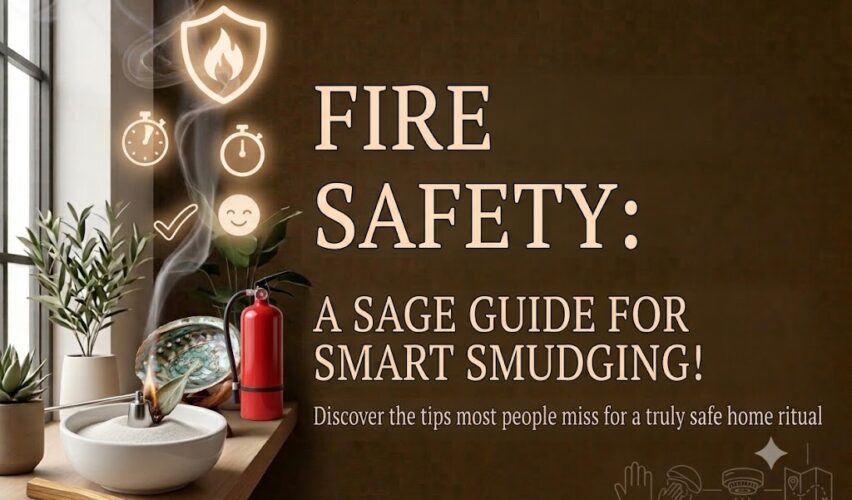
The most important fire safety tips for smudging at home are: burn your smudge stick over a fireproof, weighted container (never glass, plastic, or wood); keep it at least three feet from curtains, bedding, and paper; never leave it burning unattended, even for a few seconds; extinguish it by pressing the tip into sand or salt rather than dousing it with water; and let the ash bed cool for at least 15–20 minutes before disposal. A working smoke alarm and a nearby fire extinguisher or box of baking soda complete the setup.
That’s the summary. The rest of this guide breaks down why each step matters, the risks that generic “how to smudge” articles rarely mention, and what to do in the specific situations renters, homes with kids or pets, dry climates, wildfire season where the standard advice isn’t enough.
Why This Guide Exists (And Why Most Smudging Articles Don’t Cover It)
Search “how to smudge your home” and you’ll find dozens of guides on ritual steps, intention-setting, and cultural history. Almost all of them mention fire safety in a single sentence “use a fireproof bowl” and move on. That’s a gap, because the physical act of smudging has more in common with an open flame than most people realize: a smudge stick smolders at a visible ember temperature for 10–40 minutes, drops hot ash as it’s carried through a room, and is frequently handled by people who are moving, distracted by intention-setting, or holding it one-handed while doing something else.
Smudging isn’t separately tracked in national fire statistics, but it belongs to the same risk category as candles and other open-flame home rituals. According to the National Fire Protection Association, U.S. fire departments respond to roughly 7,600 home structure fires started by candles every year, causing dozens of deaths and hundreds of injuries and three out of five of those fires started because something flammable was too close to the flame source. A smoldering smudge stick carried through a room, past curtains, bedding, and paper, carries a comparable arguably higher risk profile, because it moves through the space instead of sitting still.
This article treats smudging fire safety as its own topic, not a footnote. If you already have a general sage-burning or smudging ritual guide, this piece is meant to sit alongside it as the safety-focused companion resource.
The Real Fire Risks of Smudging (What Actually Goes Wrong)
Before the “how,” it helps to understand exactly where fires and burns come from during smudging. In order of how often they actually cause damage:
- Falling embers. As a bundle burns down, small glowing pieces of leaf or bark break off and fall onto carpet, bedding, or a wood floor often without the person noticing.
- Prolonged, unattended smolder. Unlike a match, a smudge stick keeps smoldering after you’ve set it down. A “quick errand” of two or three minutes is enough time for it to ignite whatever it’s resting on.
- Contact with combustible materials. Curtains, paper, dry plants, upholstery, and bedding are the most common ignition points, especially when someone waves the smoke toward a corner or doorway without checking what’s behind it.
- Re-ignition after “extinguishing.” A smudge stick that looks out can still hold a hidden ember deep inside the bundle. It can flare back up in a bag, drawer, or trash can hours later.
- Wind and drafts. Open windows are recommended for ventilation, but a draft can also fan a dying ember back to life or blow ash onto nearby fabric.
- Using the wrong vessel. Thin glass can crack from heat shock; plastic can melt or ignite; wood can scorch and eventually catch.
- Loose hair, sleeves, and scarves. Anyone smudging themselves or a shrine area (a common practice) is at risk of catching hair or a sleeve on the ember.
Every recommendation in this guide exists to interrupt one of these seven failure points.
Before You Light: A Pre-Smudging Fire Safety Checklist
Treat this like pre-flight prep, not an afterthought.
- Clear a 3-foot radius around your starting point of curtains, papers, dried flowers, blankets, and anything else that burns easily.
- Choose your path in advance — know which rooms you’re walking through so you’re not improvising near shelves, bookcases, or closets.
- Have your fireproof vessel in hand before you strike a match, not after the bundle is already lit.
- Keep a fire extinguisher (or a box of baking soda) and a glass of water within reach — not to extinguish the smudge stick itself, but for an actual emergency.
- Tie back long hair and loose sleeves.
- Tell others in the house that you’re smudging, especially if children, pets, or guests are present, so no one bumps into you mid-walk.
- Check the weather and local conditions if you plan to smudge near an open window during dry, windy, or red-flag-warning conditions (more on this below).
- Confirm your smoke alarm is functioning — this is the moment to test it, not during a real fire.
Choosing a Truly Fireproof Vessel (Not Just “Fire-Safe”)
Most guides say “use an abalone shell or ceramic bowl” without explaining why material matters. Here’s the comparison:
| Vessel Material | Fire Safety Rating | Notes |
|---|---|---|
| Abalone shell / thick ceramic bowl | ✅ Excellent | Naturally heat-resistant, wide surface catches falling ash, traditional choice |
| Cast iron or stainless steel dish | ✅ Excellent | Very stable, won’t crack, but can get hot to the touch — use a heatproof trivet underneath |
| Terracotta pot or dish filled with sand/salt | ✅ Excellent | The sand doubles as an extinguishing bed |
| Thick stoneware mug or plate | ⚠️ Acceptable in a pinch | Risk of thermal cracking if the ember sits directly on one spot too long |
| Thin glass bowl or dish | ❌ Unsafe | Can shatter from thermal shock |
| Plastic tray or container | ❌ Unsafe | Can melt, warp, or ignite |
| Wood bowl or board | ❌ Unsafe | Can scorch, char, and eventually catch fire with repeated use |
| Bare hand or paper plate | ❌ Unsafe | No insulation from heat; embers can pass straight through |
Pro tip: Fill your vessel with an inch of sand, salt, or dry rice. This does double duty — it catches stray embers and gives you an instant extinguishing bed without needing water.
Safe Lighting and Handling Technique
- Light the bundle at a slight downward angle so the flame catches evenly, then blow it out gently the moment it produces a steady stream of smoke — you want a smolder, not an open flame.
- Hold the bundle over your fireproof vessel while lighting it, not over carpet or a table.
- Walk slowly and keep the vessel underneath the bundle as you move between rooms, catching any falling ash.
- Never smudge one-handed while carrying something else (a phone, a drink, a child) in the other hand.
- Avoid smudging directly under smoke detectors, hanging fabric, or low shelving.
- If you’re smudging near a mirror, shrine, or altar with candles already lit, keep at least a foot of clearance between open flames and the smoldering bundle — two heat sources in close proximity multiply the risk.
Ventilation vs. Fire Risk: Finding the Balance
Opening a window is standard smudging advice for clearing smoke — but it’s also a fire-safety trade-off that rarely gets discussed. A cross-breeze can:
- Fan a weak ember back into an active glow
- Carry sparks toward curtains or paper near the window
- Pull smoke into a hallway faster than you can follow it
The fix: open windows on the opposite side of the room from where you’re standing, not directly behind or beside your smudge stick, and avoid smudging on days with strong wind gusts indoors (yes, this happens with cross-drafts in older homes).
Smoke Detectors and Fire Alarms: What To Actually Do
This is one of the most-searched practical questions, and most articles give bad advice (“just avoid the detector”). Here’s the safer approach:
- Do not disable, remove, or cover your smoke detector’s sensor permanently. A detector you forget to reactivate defeats its entire purpose.
- Do turn on kitchen/bathroom exhaust fans to help clear smoke faster during the session.
- Do keep the smudge stick and its smoke plume at least 10 feet from any detector, and avoid lingering directly beneath one.
- If you must temporarily prevent a false alarm (for example, in a small apartment with a detector positioned right at the room’s entrance), use a manufacturer-approved hush/test button or a removable detector cover made for this purpose — and set a visible reminder (timer, sticky note on the door) to remove it the moment you’re done. Never simply pull the battery and forget about it.
- In a multi-unit building, a triggered alarm may also alert building management or the fire department automatically — check your building’s alarm system type before smudging near common walls or hallway detectors.
How to Properly Extinguish a Smudge Stick
This is where most house fires and near-misses actually happen — after the ritual, when people assume the stick is “basically out.”
Do:
- Press the burning tip firmly into sand, salt, or dirt until no smoke rises.
- Rotate the tip while pressing to make sure the ember is smothered on all sides, not just the surface.
- Hold it in place for a few extra seconds even after the smoke stops — embers can hide beneath the surface ash.
Don’t:
- Don’t blow on it to put it out. Blowing adds oxygen, which can make embers glow brighter or reignite a flame — the opposite of what you want.
- Don’t dunk it in water unless it’s an emergency. Water makes the bundle far harder to relight later, can cause it to smolder unevenly, and doesn’t guarantee you’ve reached embers buried deep inside a tightly wound bundle.
- Don’t assume “no visible smoke” means “no heat.” Touch-test the tip (carefully) or hold the back of your hand near it before storing.
After Smudging: Cooldown and Disposal
- Let the extinguished bundle sit in its sand or ash bed for at least 15–20 minutes before touching or moving it.
- Never place a smudge stick — even one that “looks” cold — directly into a trash can, paper bag, or wooden drawer. Store it in its fireproof vessel or a metal tin.
- If you’re disposing of ash and stems rather than saving the bundle, empty them into a metal container outdoors, not an indoor bin, and let them sit for a few hours before mixing with other trash.
- Wipe down the vessel once it’s fully cool so leftover residue doesn’t affect the next session’s stability.
Special Situation: Renters, Apartments, and Shared Housing
This is a gap almost no smudging guide addresses, and it matters more than most rituals do.
- Check your lease. Many rental agreements include a no-open-flame or no-smoking clause that legally extends to any combustion, including smudge sticks and incense — not just cigarettes.
- Multi-unit smoke detection systems are often centrally monitored. A triggered alarm in one unit can dispatch a fire department response for the whole building, and repeated false alarms can result in fines charged to the tenant responsible.
- HOA and condo bylaws frequently restrict indoor burning of any kind, independent of your lease.
- Renters insurance typically covers accidental fire damage you cause, but insurers can deny claims tied to “negligence” — leaving a smoldering item unattended is a common reason cited in denied claims. This isn’t legal or financial advice; check your specific policy language or ask your insurer directly if you’re unsure how it applies to you.
- If open burning isn’t allowed in your space, smokeless alternatives (below) let you keep the ritual without the fire-code conflict.
Special Situation: Homes with Kids, Pets, or Mobility-Limited Residents
- Kids: Curiosity plus a glowing object at eye-level height is a bad combination. Smudge in a separate room from young children, or hold the session when they’re occupied elsewhere, and store the extinguished stick well out of reach afterward.
- Pets: Beyond smoke sensitivity (a common topic in general smudging guides), cats and dogs can also knock over a lit vessel or bat at a hanging feather/fan near an open ember. Keep pets in a separate room, not just for air quality but for physical safety.
- Mobility-limited residents: If you or someone in the home uses a cane, walker, or wheelchair, walking room-to-room with a lit ember requires extra caution — consider a stationary setup (bundle resting in a fixed, weighted vessel with a fan gently circulating smoke) instead of carrying it through the house.
Wildfire Season and Dry-Climate Considerations
If you live in a wildfire-prone region or you’re smudging near an open window during a dry spell:
- Avoid smudging outdoors, or even near open windows facing dry vegetation, during red flag warnings or local burn bans — some jurisdictions treat any open combustion, including smudge sticks, as covered under these restrictions.
- Indoor humidity affects how a bundle burns; very dry indoor air (common in winter with heating running) can cause faster, hotter smoldering and more airborne embers.
- Keep a spray bottle of water nearby (separate from your extinguishing sand) specifically for stray sparks that land on surfaces, even if you don’t use it to extinguish the bundle itself.
Comparing Fire Risk: Smudge Sticks vs. Loose Herb vs. Resin vs. Palo Santo
Different smoke-cleansing methods carry different fire profiles — a detail almost never broken out separately in general “how to smudge” content.
| Method | How It’s Burned | Relative Fire Risk | Key Safety Note |
|---|---|---|---|
| Bundled smudge stick (sage, palo santo bundles) | Direct flame, then smolders | Highest — mobile, drops embers as it’s carried | Requires constant vessel underneath while moving |
| Loose herb on charcoal disc | Charcoal disc burns at very high heat in a fixed dish | Moderate-high — charcoal itself is a serious burn/fire hazard | Use metal tongs, a heat-isolating dish, and never touch the disc directly |
| Resin (copal, frankincense) on charcoal | Same charcoal-disc method | Moderate-high | Same charcoal precautions apply |
| Palo Santo sticks (stick form, not bundle) | Lit directly, self-extinguishes faster than sage | Lower — burns out on its own more readily | Still needs a fireproof dish; don’t leave unattended |
| Smokeless alternatives (mists, salt lamps, essential oil diffusers) | No open flame or ember | Lowest | Best option where open burning isn’t permitted |
What To Do If a Small Fire Starts
Even with every precaution, know the response before you need it:
- Stay calm and act immediately — small ember fires spread fast on fabric but are usually easy to smother in the first seconds.
- Smother, don’t fan. Cover the flame with a non-flammable lid, a fire blanket, or baking soda. Never use water on anything involving hot ash and never spray water on an electrical source.
- Use a Class A fire extinguisher (rated for ordinary combustibles like fabric and paper) if the fire has spread beyond something you can smother by hand.
- If it doesn’t go out within seconds, or smoke fills the room quickly, evacuate and call 911 — don’t keep trying once a fire is spreading; property is replaceable, you aren’t.
- After any fire, even a small extinguished one, check the surrounding material (mattress, upholstery, insulation) for hidden smoldering before leaving the room, since some materials can re-ignite from residual heat hours later.
Common Fire-Safety Mistakes People Make While Smudging
- Setting the bundle down on a nightstand or windowsill “for a second” mid-ritual
- Using a decorative bowl that looks fireproof but is thin glass or has a plastic base
- Smudging directly beneath a smoke detector to “get it over with faster”
- Blowing on the ember to relight it instead of using a match or lighter
- Assuming a bundle is fully out because the smoke has stopped
- Storing an extinguished bundle in a paper bag, drawer, or trash can
- Smudging near open candles, incense, or diffusers without spacing them apart
- Skipping the fireproof vessel entirely for a “quick” self-smudge
Frequently Asked Questions
Is smudging a fire hazard? Yes, in the same category as candles or incense. The main risks are falling embers, unattended smoldering, and contact with flammable material like curtains or bedding — not the smoke itself.
What is the safest container to smudge over? A thick ceramic bowl, abalone shell, cast iron dish, or a container filled with sand or salt. Avoid thin glass, plastic, or wood.
Can I put out a smudge stick with water? It’s not recommended as a first choice. Water makes the bundle harder to relight and doesn’t reliably reach embers buried inside a tightly wound bundle. Press the tip into sand or salt instead, and reserve water for emergencies.
Will smudging set off my smoke alarm? It’s possible, especially in small rooms or apartments with sensitive detectors. Keep smoke away from the detector, run an exhaust fan, and never disable a detector permanently to avoid a false alarm.
How long should I let a smudge stick cool before storing it? At least 15–20 minutes in its fireproof vessel, and confirm there’s no residual heat before placing it in a drawer, bag, or box.
Is smudging allowed in apartments? It depends on your lease and building fire code. Many leases restrict open flame or combustion of any kind, and centrally monitored smoke detectors can trigger a building-wide response. Check your lease or ask your landlord before smudging indoors.
Does homeowners or renters insurance cover a fire caused by smudging? Most policies cover accidental fires, but claims can be denied if the fire is linked to negligence, such as leaving a smoldering item unattended. This is general information, not legal or insurance advice — confirm your specific coverage with your provider.
What’s a safer alternative if I can’t burn anything indoors? Smokeless options like herb-infused mists, essential oil diffusers, or sound-based clearing (bells, chimes) accomplish a similar ritual intention without an open flame or ember.
Quick-Reference Fire Safety Checklist
- Fireproof vessel (ceramic, shell, or metal — filled with sand/salt) ready before lighting
- 3-foot clearance from curtains, bedding, and paper
- Smoke alarm tested and working
- Fire extinguisher or baking soda within reach
- Hair tied back, loose sleeves secured
- Never left unattended, even briefly
- Extinguished by pressing into sand/salt, not blown out or doused
- Cooled 15–20 minutes before storage or disposal
- Disposed of in a metal container, never a paper bag or plastic bin while warm
- Lease/building rules checked if renting or in a shared building
Final Thoughts
Smudging is a centuries-old practice, and treating it with real fire safety doesn’t take anything away from its meaning — if anything, the deliberate, unhurried pace that proper fire safety requires (choosing your vessel, watching the ember, extinguishing it fully) fits naturally with the intention-setting side of the ritual. The goal of this guide isn’t to discourage smudging; it’s to close the gap that general how-to-smudge content leaves open, so the practice stays safe for you, your home, and everyone in it.
If you’re new to the practice itself — what to burn, how to move through a space, and the cultural traditions behind it — [see our full guide to sage burning and smudging] for the ritual side of things. This article is meant to be read alongside it as the safety chapter that’s usually missing.
Sources Referenced
- National Fire Protection Association (NFPA), Candle Fires report — nfpa.org/education-and-research/research/nfpa-research/fire-statistical-reports/candle-fires
- National Fire Protection Association (NFPA), Safety with Candles — nfpa.org/education-and-research/home-fire-safety/candles
SEO / AEO / GEO Implementation Notes
(Internal notes for your CMS — remove before publishing)
On-page SEO
- H1 and title tag both lead with the exact focus keyword: “Fire Safety Tips for Smudging at Home.”
- Keyword and close variants (“smudging fire safety,” “fire safety while smudging,” “smudge stick fire risk”) are distributed naturally across H2s and body copy — avoid forcing the exact phrase into every paragraph.
- Internal link this piece to your existing sage-burning/smudging article both ways: link out to it from the intro and conclusion, and add a link back in from your general guide’s safety section pointing here as “the full fire-safety breakdown.” This is the core of the topical cluster and signals depth to both search engines and generative answer engines.
AEO (Answer Engine Optimization)
- The “Quick Answer” block at the top is written as a self-contained, 60–80 word direct answer — this is what search features and voice assistants pull from. Keep it as the literal first content block on the page, above any imagery.
- The FAQ section uses question-phrased H3s that mirror real “People Also Ask” query patterns. Mark this section up with
FAQPageschema. - Mark the checklist section up with
HowToschema if your CMS supports it; each checklist line can map to astep.
GEO / AIO (Generative Engine Optimization)
- Every major claim is stated as a standalone, fully-attributed sentence (subject + claim + source) rather than buried in narrative — this is the format LLM-based answer engines preferentially extract and cite.
- Statistics are sourced explicitly (NFPA) with a linked citation at the bottom rather than vague “studies show” phrasing — generative engines weight named, checkable sources more heavily when selecting content to surface or cite.
- Comparison tables (vessel materials, burning methods) are structured for easy extraction into AI-generated comparison answers — keep these as true Markdown/HTML tables in your CMS rather than images.
- Definitional clarity (“a smudge stick smolders at a visible ember temperature for 10–40 minutes”) gives generative models concrete facts to quote/paraphrase, which increases citation likelihood versus vaguer competitor content.
AdSense / content-quality signals
- Word count (~2,600 words) and original comparative analysis (fire-risk-by-method table, renters/insurance section, wildfire-season section) exceed thin-content thresholds and differentiate this from templated smudging guides.
- Add 3–4 original images: a labeled photo of a proper fireproof setup, an infographic version of the checklist, and a comparison graphic of vessel materials. Avoid stock photos with no added value — AdSense reviewers and users both respond to original, purpose-built visuals.
- Add a visible last-updated date and a short author/reviewer bio line (even “Reviewed for accuracy against NFPA guidance”) — E-E-A-T signals matter for both AdSense approval and generative engine trust scoring.