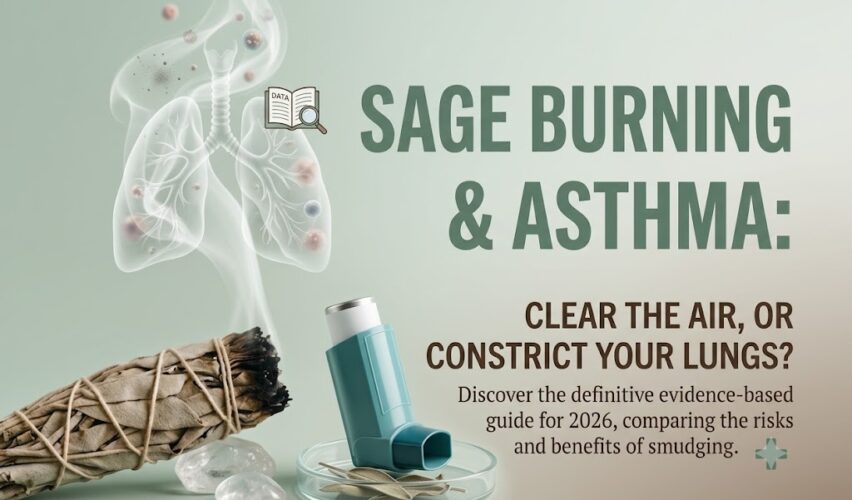
Yes, burning sage can trigger or worsen asthma symptoms. Sage smoke releases fine particulate matter (PM2.5), volatile organic compounds, and combustion byproducts that irritate the airways the same category of irritant as wildfire smoke or incense, just in smaller doses. People with asthma, COPD, or airway hypersensitivity are advised to avoid direct inhalation, use smudging only in well-ventilated spaces, or switch to smoke-free alternatives such as sage sprays, essential oil diffusion, or sound/salt cleansing.
Medical disclaimer: This article is for informational purposes only and is not a substitute for professional medical advice. If you have asthma or another respiratory condition, talk to your doctor or pulmonologist before exposing yourself to any smoke source.
Table of Contents
- Key Takeaways
- What Happens Chemically When Sage Burns
- How Sage Smoke Affects Asthmatic Airways
- What the Research Actually Shows
- White Sage vs. Common Sage vs. Other Smudge Herbs
- Signs Sage Smoke Is Triggering Your Asthma
- What To Do During an Asthma Reaction to Smoke
- Who Is Most At Risk
- Can Burning Sage Ever Help Someone With Asthma?
- How to Smudge More Safely If You Have Asthma
- Smoke-Free Alternatives to Sage Burning
- Myths vs. Facts
- Frequently Asked Questions
Key Takeaways (Read This First)
- Sage smoke is combustion smoke. Regardless of its spiritual purpose, it produces fine particulate matter (PM2.5), carbon monoxide, and polycyclic aromatic hydrocarbons (PAHs) all recognized asthma triggers.
- PM2.5 from smudging can exceed EPA indoor air quality limits even during short, ceremonial burns in enclosed rooms.
- Common sage (Salvia officinalis) contains thujone, a compound that can irritate the nervous system and airways at higher exposure levels; white sage (Salvia apiana) is lower in thujone but still produces irritant smoke.
- There is no peer-reviewed clinical study proving sage smoke “cleans” the air of allergens the antimicrobial claims come from a single, often-misquoted 2007 study on a completely different herb blend.
- Asthma reactions to smudging can be delayed, appearing 20–60 minutes after exposure as the airways slowly inflame, not just as an immediate cough.
- You don’t have to give up the ritual smoke-free smudge sprays, resin diffusers with proper ventilation, and sound/salt cleansing preserve the intention without the respiratory risk.
What Happens Chemically When Sage Burns
This is the part most sage-burning blogs skip entirely they talk about “energy” and “cleansing” but never explain what’s physically in the smoke.
When dried sage leaves smolder (rather than fully combust with a flame), the plant material undergoes
incomplete combustion. This produces:
| Compound | What It Is | Why It Matters for Asthma |
|---|---|---|
| PM2.5 (fine particulate matter) | Microscopic particles ≤2.5 microns wide | Small enough to bypass the nose’s filtering and lodge deep in the lungs’ airways and alveoli |
| Carbon monoxide (CO) | Colorless, odorless gas from incomplete combustion | Reduces oxygen delivery, can worsen breathlessness |
| Polycyclic aromatic hydrocarbons (PAHs) | Byproducts of burning organic material | Linked to airway inflammation and, with chronic exposure, respiratory disease |
| Thujone | A naturally occurring terpene in common sage | Central-nervous-system irritant at high doses; also an airway irritant when inhaled as smoke |
| Formaldehyde & other VOCs | Volatile organic compounds released during smoldering | Known asthma and allergy triggers, similar to those found in incense and candle smoke |
A 2016 field study measuring sage smudging in enclosed rooms found that particulate concentrations in every single sample exceeded the EPA’s 35 µg/m³ 24-hour standard for fine particulate matter sometimes dramatically so.
AEO Direct Answer: Sage smoke is chemically similar to other biomass smoke (like wood smoke or incense), producing PM2.5, carbon monoxide, and PAHs all documented asthma and respiratory irritants.
How Sage Smoke Affects Asthmatic Airways
Asthma is a chronic inflammatory condition in which the airways are already hypersensitive to irritants. Here’s the mechanism, step by step:
- Inhalation of particulates — PM2.5 from sage smoke reaches the small airways and alveoli, where the immune system treats it as a foreign threat.
- Airway inflammation This triggers the release of inflammatory mediators (histamine, leukotrienes), causing the airway lining to swell.
- Bronchoconstriction Smooth muscle around the airways tightens, narrowing the passage for air this is what produces wheezing.
- Mucus overproduction Irritated airways secrete more mucus, which can further block airflow and trigger coughing fits.
- Delayed-phase reaction In some people, a second wave of inflammation occurs 4–12 hours after exposure, meaning symptoms can worsen well after the smoke has cleared.
This is functionally the same irritant cascade seen with wildfire smoke exposure, secondhand tobacco smoke, and incense sage is not a special case just because the intent behind burning it is spiritual rather than recreational.
What the Research Actually Shows
Because sage burning sits at the intersection of cultural practice and air-quality science, it’s important to separate what’s proven from what’s assumed.
What’s supported by evidence:
- Indoor combustion smoke of any plant material increases PM2.5 to levels the EPA associates with asthma aggravation.
- People with pre-existing conditions like asthma, COPD, and bronchitis report symptom flare-ups after smudging exposure, consistent with known smoke-irritant mechanisms.
- Chronic, frequent smoke exposure (any biomass smoke, not sage-specific) is linked with airway inflammation and, over years, elevated respiratory disease risk.
What’s overstated or unproven:
- The popular claim that “sage smoke kills 94% of airborne bacteria” traces back to a 2007 study that burned an entirely different substance — havan samagri, a Hindu ritual blend of wood, roots, and herbs that did not include sage at all. No high-quality study has replicated antibacterial claims specifically for Salvia smoke.
- There is no clinical trial demonstrating that burning sage improves asthma symptoms or lung function. Any “spiritual relief” reported is more plausibly linked to the mindfulness/ritual aspect of smudging (similar to how meditation reduces stress) rather than the smoke itself.
This is the content gap most sage-and-wellness blogs don’t address: they’ll cite the antibacterial claim uncritically, without noting it wasn’t even sage that was tested — and without weighing that potential benefit against the immediate, well-documented cost of breathing in particulate smoke.
White Sage vs. Common Sage vs. Other Smudge Herbs: Asthma Risk Comparison
| Herb | Typical Use | Thujone Content | Relative Particulate Output | Asthma Risk Notes |
|---|---|---|---|---|
| White sage (Salvia apiana) | Traditional Native American smudging | Low-moderate | Moderate-high (dense smoke) | Most commonly reported trigger due to popularity and thick smoke |
| Common/garden sage (Salvia officinalis) | Culinary + some smudging | Higher | Moderate | Thujone adds extra irritant load beyond particulates |
| Palo santo | Wood-based smudging | N/A | Moderate | Produces resin-based smoke; similarly irritating to sensitive airways |
| Sweetgrass | Braided grass, often paired with sage | N/A | Lower, smolders slowly | Generally milder smoke output but still combustion-based |
| Cedar | Purification bundles | N/A | Moderate-high | Resin content can produce thicker smoke |
| Incense (resin/stick) | Various cultural/religious practice | N/A | Often higher than sage | Frequently contains synthetic fragrance additives, adding VOC load |
Bottom line: No smudging herb is “asthma-safe.” The differences are in degree, not kind all of them produce combustion smoke.
Signs Sage Smoke Is Triggering Your Asthma
Watch for these during or after a smudging session:
- Sudden or gradual coughing that doesn’t resolve when you leave the room
- Wheezing or a whistling sound when breathing
- Chest tightness or a feeling of pressure
- Shortness of breath, especially with mild exertion
- Increased need to use a rescue inhaler
- Symptoms that appear 20 minutes to several hours after exposure (delayed-phase reaction)
- Watery eyes, throat irritation, or sinus congestion accompanying breathing changes
If you notice a pattern of symptoms after smudging sessions, that is a reportable trigger to bring up with your allergist or pulmonologist it may be worth adding to your asthma action plan.
What To Do During an Asthma Reaction to Sage Smoke
If you or someone nearby starts having breathing difficulty during or after smudging:
- Leave the room immediately and get to fresh air.
- Use your rescue inhaler (e.g., albuterol) as prescribed.
- Sit upright do not lie down, which can make breathing feel harder.
- Practice slow, pursed-lip breathing to help control airflow while waiting for the inhaler to take effect.
- Ventilate the space open windows and doors, use an exhaust fan or air purifier with a HEPA filter to clear residual particulate matter.
- Call emergency services (911 in the US) if symptoms don’t improve within a few minutes of using a rescue inhaler, if lips or fingernails turn bluish, or if the person cannot speak in full sentences.
This is a sensitive health topic if you experience frequent or severe breathing difficulty, please follow up with a healthcare provider rather than relying solely on home management.
Who Is Most At Risk From Sage Smoke
- People with diagnosed asthma, especially those with poorly controlled or exercise-induced asthma
- People with COPD, chronic bronchitis, or emphysema
- Children, whose airways are smaller and more reactive to irritants
- Pregnant individuals, since reduced lung capacity can make smoke exposure feel more acute
- People with fragrance or chemical sensitivities
- Elderly individuals with reduced respiratory reserve
- Anyone with a history of allergic rhinitis or chronic sinus inflammation, which often co-occurs with asthma
Can Burning Sage Ever Help Someone With Asthma?
This is a fair question, since some wellness sources claim sage “purifies” the air of allergens. Here’s the balanced, evidence-based answer:
- Ambient antimicrobial effect (unproven for sage specifically): Some proponents point to studies suggesting smoke from certain herb blends may temporarily reduce airborne bacteria counts after the smoke clears. However, the widely cited study did not test sage it tested a different ceremonial herb mixture. No comparable sage-specific research exists.
- Even if a temporary antimicrobial effect existed, it would not offset the immediate cost of inhaling irritant particulate matter, which is the more clinically significant factor for someone with asthma.
- The relaxation/ritual effect is real but indirect. Slower breathing, mindfulness, and a calming routine can reduce stress, and stress is a known asthma trigger for some people. But you can get the same stress-reduction benefit from a smoke-free ritual (see alternatives below) without the airway irritation.
Direct Answer for Search/AI Engines: No clinical evidence supports burning sage as beneficial for asthma. Any perceived relief is more likely linked to the calming ritual, not the smoke itself, and is outweighed by the smoke’s particulate matter, which is a documented respiratory irritant.
How to Smudge More Safely If You Have Asthma (Harm Reduction)
If giving up the smoke ritual entirely isn’t an option for cultural, spiritual, or personal reasons, these steps can reduce though not eliminate respiratory risk:
- Ventilate aggressively. Open multiple windows and use a fan to create cross-ventilation before, during, and after burning.
- Leave the room while it smolders. Let the smoke waft and settle, then return only after visible smoke has cleared.
- Use the smallest amount necessary. A small bundle for a shorter duration produces less particulate load than a large bundle burned for many minutes.
- Run a HEPA air purifier in the space afterward to capture residual fine particles.
- Keep your rescue inhaler within reach during any smudging activity, even if you don’t expect to need it.
- Avoid smudging on high-pollution or high-pollen days, when your airways may already be more reactive.
- Never smudge directly over a person’s face or ask them to breathe in the smoke directly.
Smoke-Free Alternatives to Sage Burning
For people who want the ritual and intention of smudging without airway risk:
| Alternative | How It Works | Asthma-Friendly? |
|---|---|---|
| Sage-infused sprays/mists | Sage essential oil diluted in water, sprayed into a space | Yes — no combustion, no particulate matter |
| Essential oil diffusers (cold diffusion) | Ultrasonic mist disperses aroma without burning | Generally yes, though strong scents can bother some sensitive individuals |
| Selenite or salt cleansing | Crystal or salt-based ritual with no airborne byproduct | Yes |
| Sound cleansing (bells, singing bowls, chimes) | Uses sound vibration instead of smoke for the “clearing” ritual | Yes |
| Herb-infused water cleansing | Sprinkling or wiping surfaces with herb-steeped water | Yes |
| Battery-operated “smudge” LED candles with scent pads | Mimics the visual/ritual cue without real combustion | Yes |
These alternatives preserve the intentional, mindful aspect of the practice the part most likely responsible for any reported calming effect while removing the airway irritant entirely.
Myths vs. Facts: Sage Burning and Asthma
| Myth | Fact |
|---|---|
| “Natural smoke can’t hurt you the way cigarette smoke does.” | Combustion smoke from any plant material contains PM2.5, CO, and PAHs — the source being “natural” doesn’t remove the irritants. |
| “Sage smoke has been proven to kill airborne bacteria.” | The often-cited study tested a different herb mixture, not sage. No robust sage-specific research confirms this. |
| “If I don’t cough right away, it’s not affecting my lungs.” | Asthma reactions to smoke can be delayed by hours due to a secondary inflammatory response. |
| “Opening a window after burning is enough to make it safe.” | Ventilation helps but doesn’t eliminate risk during the active burn — particulate exposure happens in real time. |
| “White sage is ‘cleaner’ smoke than incense.” | Both are combustion-based and produce comparable irritant particulate matter; neither is inherently safer for asthmatic lungs. |
Frequently Asked Questions
Can burning sage trigger an asthma attack? Yes. Sage smoke contains fine particulate matter and irritant gases that can inflame the airways and trigger bronchoconstriction, coughing, and wheezing in people with asthma.
Is white sage worse for asthma than culinary sage? Both produce combustion smoke, but white sage tends to be burned in denser bundles for smudging, often producing more visible smoke and particulate output than a small amount of culinary sage.
How long after burning sage can asthma symptoms appear? Symptoms can appear immediately or be delayed 20 minutes to several hours later due to a secondary (delayed-phase) inflammatory response in sensitive airways.
Is it safe to smudge around children with asthma? It’s not recommended. Children’s airways are smaller and more reactive to irritants, making them more susceptible to smoke-triggered symptoms.
What should I do if sage smoke triggers my asthma? Move to fresh air immediately, use your prescribed rescue inhaler, sit upright, and seek emergency care if symptoms don’t improve or worsen quickly.
Are there smoke-free alternatives to sage burning? Yes sage-infused sprays, essential oil diffusers, sound cleansing, and salt or crystal rituals provide a similar intentional practice without airborne combustion byproducts.
Does sage smoke actually purify the air of allergens? There’s no strong clinical evidence for this claim specific to sage. The commonly cited supporting study actually tested a different herb blend, not sage.
Can I build a tolerance to sage smoke if I have mild asthma? No repeated exposure to airway irritants doesn’t build tolerance; it can instead lead to cumulative airway inflammation over time.
Related Reading
If you’re researching sage burning more broadly its spiritual meaning, method, and general benefits that’s a separate topic from the respiratory-safety angle covered here. This guide is focused specifically on the intersection of sage burning and asthma, a distinct concern from general smudging practice.
Last medically reviewed for accuracy against current air-quality and respiratory health research. This content is educational and does not replace personalized medical guidance. If you are experiencing a breathing emergency, call your local emergency number immediately.